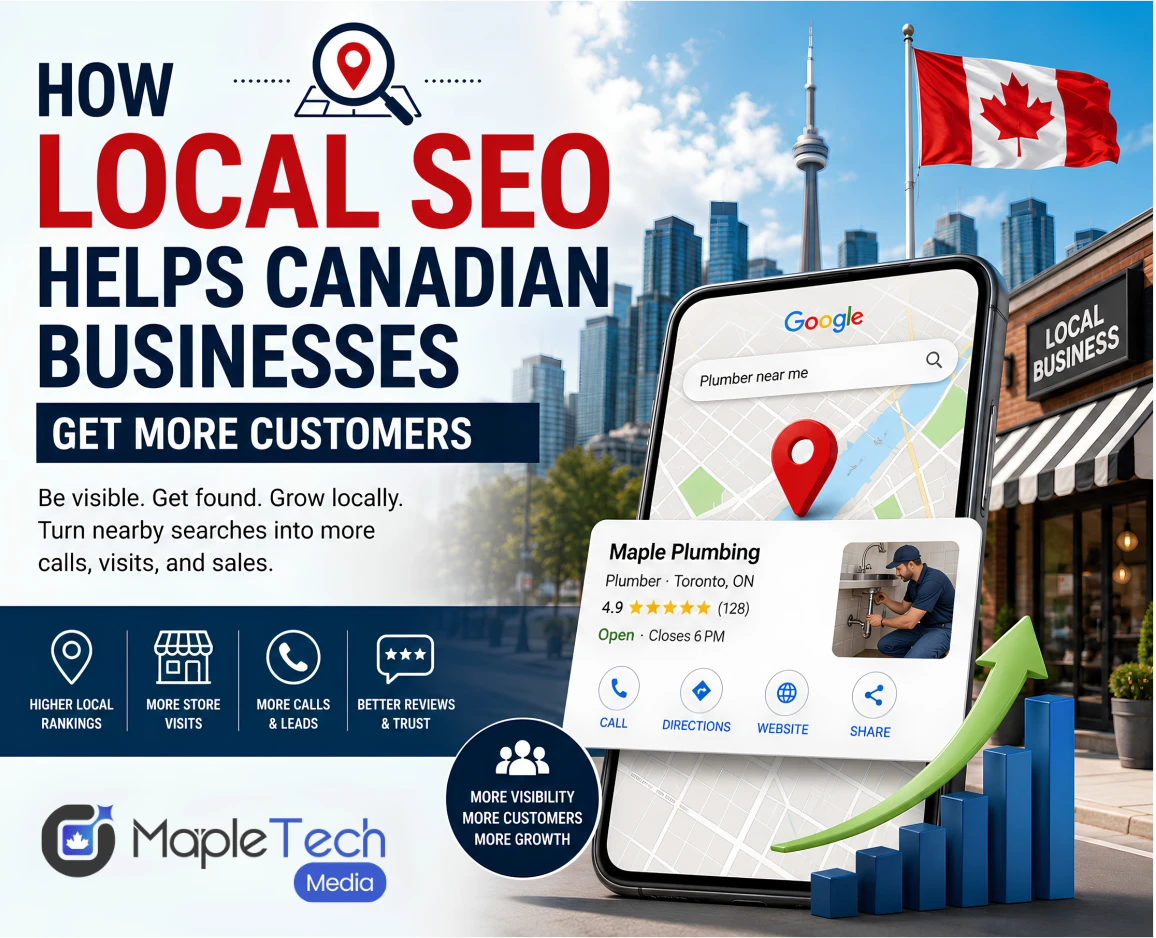
When someone in Toronto searches for a plumber, a person in Calgary looks for a dental clinic, or a customer in Vancouver searches for a nearby restaurant, they usually aren’t looking for a business on the other side of the country.
They want something close, reliable and easy to contact.
That is where local SEO comes in.
Local SEO helps businesses become more visible when people search for products or services in a specific city, neighbourhood or service area. Instead of trying to reach everyone across Canada, it helps you reach the people who are most likely to become customers in the areas you actually serve.
For Canadian small businesses, this can make a significant difference. A strong local search presence can help a business appear in Google Search, Google Maps and local search results when potential customers are actively looking for what it offers.
Google explains that local search rankings are primarily influenced by relevance, distance and prominence. Businesses with complete and accurate information are more likely to appear for relevant local searches.
So, if your business serves a specific Canadian city or community, local SEO should not be treated as an optional marketing tactic. It should be part of your overall digital marketing strategy.
Table of Contents
What Is Local SEO?
Local SEO is the process of improving a business’s online presence so it can appear more prominently in searches connected to a specific geographic area.
Traditional SEO can help a website rank for broader searches, while local SEO focuses on searches with local intent.
For example:
- plumber in Toronto
- dentist near me
- roofing company Calgary
- restaurants in Vancouver
- accountant in Mississauga
- physiotherapist near me
- auto repair shop Edmonton
- local marketing agency in Ottawa
Some searches include a city or neighbourhood. Others don’t.
A customer might simply search for “coffee shop near me.” Google can use the searcher’s location and other information to understand that the person is looking for a nearby business.
Local SEO focuses on helping Google understand three important things:
- What your business does
- Where your business operates
- Why your business should be trusted
When those signals are clear and consistent, your business has a better opportunity to appear when local customers are searching.
Why Local SEO Matters for Canadian Businesses
Canada is a large country, but most local businesses do not need customers from every province.
A roofing company in Calgary doesn’t need someone searching from Halifax. A family-owned restaurant in Ottawa isn’t trying to attract customers from Winnipeg.
The goal is much more specific:
- Get in front of the right people in the right location at the right time.
- That’s one of the biggest advantages of local SEO.
Statistics Canada continues to track the growing role of online activity and e-commerce among Canadian businesses. Its latest business data includes online sales by province, industry and business size, showing how important digital channels have become for Canadian businesses.
For local businesses, online visibility isn’t only about selling something online. It can influence whether someone calls, visits a store, requests a quote, books an appointment or asks for directions.
A customer may search for a business before ever visiting its website. If your competitors appear in those local results and your business doesn’t, you may lose the customer before they even know your business exists.
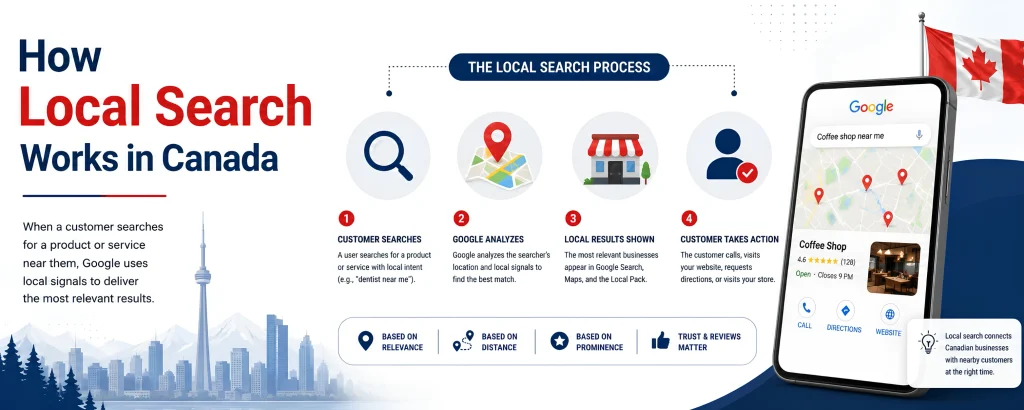
How Local Search Works in Canada
Local search results can appear in several places.
Google Search
A customer may search for a service and see local businesses alongside traditional organic results.
Google Maps
Customers can search directly on Google Maps to find businesses, compare options, read reviews, check hours and get directions.
The Local Pack
For many location-based searches, Google displays a map and a group of local business listings near the top of the results.
This area is often called the Local Pack or Map Pack. Being visible here can put your business directly in front of customers who are already looking for a service.
Organic Search Results
Your website can also appear in traditional organic search results for location-based searches.
For example, a landscaping company might have a page targeting:
Landscaping Services in Mississauga
That page can potentially attract people searching for landscaping services in that market.
The strongest local SEO strategies usually work across these different areas rather than focusing on just one.
How Google Determines Local Rankings
Google says local results are mainly influenced by relevance, distance and prominence.
Understanding these three factors makes local SEO much easier to understand.
1. Relevance
Relevance means how closely your business matches what the customer is searching for.
If someone searches for “emergency plumber,” Google needs to determine which businesses actually provide that service.
Your business information, categories, services and website content can help Google understand what you offer.
This is why accurate information matters.
You don’t want Google guessing whether your business is a plumber, contractor, renovation company or something else.
Your services should be clearly explained.
2. Distance
Distance refers to how close the business is to the person searching.
This is one factor that businesses cannot completely control.
A customer searching from downtown Toronto may see different local businesses than someone searching from North York.
The physical location of a business matters in local search.
This is also why trying to create misleading locations or fake business addresses is not a sustainable local SEO strategy.
3. Prominence
Prominence is essentially about how established and well-known a business appears to be.
Google considers information from different sources when determining local results. Reviews, links and other online references can contribute to a business’s overall prominence.
This is where ongoing local SEO work becomes important. A complete Google Business Profile is useful, but local visibility isn’t built through one update.
It takes consistent work across your website, business listings, reviews, content and online presence.
How Local SEO Helps Businesses Get More Customers
Local SEO isn’t simply about ranking higher.
The real objective is to turn local visibility into calls, enquiries, bookings, visits and sales. Here are some of the main ways it can help.
1. It Helps Customers Find Your Business
Imagine someone needs a furnace repair in Edmonton.
They open Google and search for a furnace repair company nearby. If your business appears in the local results, you have an opportunity to earn that customer’s attention.
If you’re nowhere to be found, the customer may contact a competitor instead. This is one of the simplest benefits of local SEO: It puts your business where customers are already looking.
2. It Improves Google Maps Visibility
Google Maps has become an important part of how people find local businesses.
Customers can use Maps to:
- Find nearby businesses
- Compare businesses
- Read reviews
- View photos
- Check opening hours
- Visit a website
- Call a business
- Request directions
A well-managed Google Business Profile gives potential customers useful information before they even visit your website.
Google recommends verifying your business and keeping its information complete and accurate to improve your chances of appearing in relevant local results.
For businesses that depend heavily on local customers, Google Maps visibility can be a major source of enquiries.
3. It Generates More Qualified Leads
Not every website visitor is a potential customer.
Someone reading a general article about plumbing may be researching a problem.
Someone searching:
“emergency plumber in Calgary”
has a much stronger local and commercial intent.
That distinction matters.
Local SEO helps businesses target people who are searching for a specific service in a specific area.
These searches can produce highly relevant traffic because the customer already has a need.
For service-based businesses, this can mean more:
- Phone calls
- Quote requests
- Appointment bookings
- Contact form submissions
- Directions requests
- Store visits
The goal isn’t simply to increase traffic. The goal is to attract the right traffic.
4. It Builds Trust Before Customers Contact You
Local customers often compare several businesses before making a decision.
They may look at:
- Google reviews
- Star ratings
- Business photos
- Services
- Opening hours
- Website quality
- Location
- Customer comments
This means your local search presence becomes part of your first impression.
A business with accurate information, recent reviews, useful photos and a professional website can make a much stronger impression than a business with an incomplete listing.
Reviews are especially important because customers often want reassurance before contacting a business they have never used.
5. It Brings More Traffic to Your Website
Local SEO doesn’t replace your website. It can actually help send more relevant visitors to it.
For example, a Toronto-based accounting firm could target searches related to:
- accountant Toronto
- small business accountant Toronto
- tax accountant Toronto
- bookkeeping services Toronto
Instead of relying on one homepage, the company can create useful pages around its actual services and locations.
When those pages match search intent, they can attract people who are looking for those services. The result is a stronger connection between Google search → website → enquiry.
6. It Helps Strengthen Your Online Reputation
Your reputation exists beyond your website.
Customers can encounter your business through:
- Google Maps
- Business directories
- Social platforms
- Review websites
- Local publications
- Industry websites
If your business information is inconsistent across these places, customers may become confused.
For example, your website may show one phone number while an old directory listing displays another.
Local SEO involves keeping important business information consistent and accurate.
This includes your:
- Name
- Address
- Phone number
Often referred to as NAP consistency. Keeping this information accurate helps create a more trustworthy online presence.
7. It Gives Small Businesses a Chance to Compete
One common misconception is that large companies automatically dominate search results.
Local SEO can create opportunities for smaller businesses because local search is connected to geographic relevance.
A family-owned business may not have the advertising budget of a national brand. But it can build a strong local presence by becoming highly relevant within the community it serves.
For example, a local HVAC company in Ottawa doesn’t necessarily need to compete with every HVAC company in Canada.
It needs to establish strong visibility for the customers it serves in Ottawa and surrounding areas. That’s a much more realistic marketing goal.
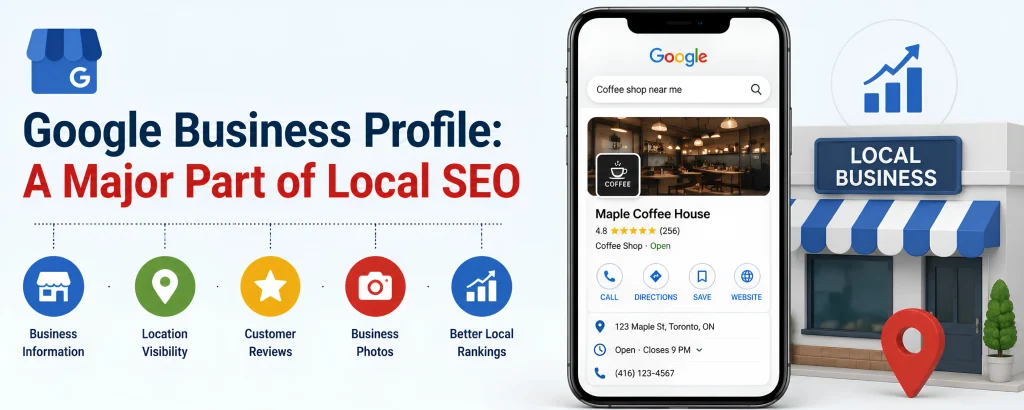
Google Business Profile: A Major Part of Local SEO
One of the first areas a Canadian business should review is its Google Business Profile.
Your profile should accurately communicate:
- Business name
- Primary category
- Additional relevant categories
- Address or service area
- Phone number
- Website
- Opening hours
- Services
- Business description
- Photos
- Customer reviews
Google recommends keeping Business Profile information complete and up to date because accurate information can help businesses appear in relevant local searches.
However, optimisation doesn’t mean adding keywords everywhere.
Your business name should represent your actual business name rather than being stuffed with search terms.
The goal is to provide useful, accurate information that helps both Google and customers understand your business.
Local Keyword Research
Keyword research is still important for local SEO, but the approach is different from broad national SEO.
Instead of only looking for high-volume keywords, you should identify searches that reflect what your local customers actually need.
For example, a dentist in Vancouver could target:
- dentist Vancouver
- family dentist Vancouver
- emergency dentist Vancouver
- dental clinic Vancouver
- teeth cleaning Vancouver
A plumber in Winnipeg might target:
- plumber Winnipeg
- emergency plumber Winnipeg
- plumbing services Winnipeg
- residential plumber Winnipeg
- drain cleaning Winnipeg
The best keywords usually connect:
Service + Location + Customer Intent
Don’t force a city name into every sentence.
Write naturally for customers first and use location terms where they genuinely make sense.
Local On-Page SEO
Your website should support your local search strategy.
Important pages may include:
- Homepage
- Service pages
- Location pages
- Contact page
- About page
- Service-area pages
- Local blog content
For example, a landscaping company serving Calgary and surrounding communities could have individual pages for its core services.
A service page might focus on:
Lawn Care Services in Calgary
Another could focus on:
Landscape Design in Calgary
The content should explain the service, who it is for, the areas served, what customers can expect and why they should choose the company.
Good local content is not simply a page with a city name inserted 50 times.
It should actually be useful.
Local Citations and Business Listings
Local citations are online mentions of your business information.
These can appear on:
- Canadian business directories
- Industry directories
- Local websites
- Business associations
- Review platforms
- Community websites
The quality of these listings matters more than simply creating hundreds of random profiles.
Your goal should be to establish accurate, trustworthy references to your business.
If your business moves, changes its phone number or updates its information, older listings should also be reviewed.
Consistency is important because customers and search engines should not have to figure out which information is correct.
Customer Reviews and Local SEO
Reviews can influence how customers perceive your business and are also part of the local search environment.
Google states that prominence can be influenced by information such as reviews and links from other websites.
The best approach is simple:
Provide a good customer experience and make it easy for satisfied customers to leave honest feedback.
- Don’t buy fake reviews.
- Don’t create reviews yourself.
- Don’t pressure customers into leaving misleading feedback.
Instead, create a straightforward review process.
After completing a project, serving a customer or finishing an appointment, you can politely ask whether they would be willing to share their experience.
You should also respond professionally to reviews, including negative ones. A thoughtful response can show potential customers that your business takes feedback seriously.
Creating Local Content That Customers Actually Want
Local SEO content should answer questions people in your service area are genuinely asking.
For example, a roofing company could publish:
- How Much Does a New Roof Cost in Ontario?
- How to Prepare Your Roof for a Canadian Winter
- When Should You Replace Your Roof in Toronto?
- Signs Your Calgary Home May Need Roof Repairs
A dental clinic could create:
- How Often Should You Visit a Dentist in Canada?
- What to Expect During a Dental Cleaning
- Emergency Dental Care: When Should You Call a Dentist?
- How to Find the Right Family Dentist in Vancouver
This type of content can help establish topical relevance while giving potential customers useful information.
It also gives your website more opportunities to appear for long-tail searches.
Building Local Backlinks
Backlinks remain useful for building website authority.
For local businesses, however, you don’t need to chase every possible backlink. Relevant local links can be more valuable than random links from unrelated websites.
Potential opportunities include:
- Local newspapers
- Community organisations
- Business associations
- Local sponsorships
- Industry associations
- Local events
- Community partnerships
- Canadian business directories
- Local publications
For example, a local business sponsoring a community event may have an opportunity to be mentioned on the event organiser’s website.
These relationships can provide genuine exposure while also strengthening the business’s local online presence.
Mobile Search and “Near Me” Searches
A large portion of local searching happens when people are away from their desks.
Someone may be driving through a neighbourhood and search for:
“mechanic near me”
Someone may be shopping and search:
“shoe store near me”
Someone may suddenly need help and search:
“24-hour plumber near me”
Your website and Google Business Profile should therefore provide information that is easy to access on a mobile device.
Customers should quickly be able to find:
- Your phone number
- Address
- Hours
- Services
- Directions
- Booking options
- Website
If someone has to search through your website for basic information, you may lose the enquiry.
Local SEO for Different Canadian Businesses
Local SEO isn’t limited to one type of company.
Contractors
Contractors can use local SEO to target searches for:
- Plumbers
- Electricians
- Roofers
- HVAC companies
- General contractors
- Renovation companies
- Landscaping services
These businesses often depend heavily on customers within specific service areas.
Professional Services
Lawyers, accountants, insurance brokers, consultants and financial professionals can benefit from location-based service pages and helpful local content.
For example:
Family Lawyer in Ottawa
is much more specific than simply:
Family Lawyer
Healthcare Businesses
Dentists, physiotherapists, chiropractors, clinics and other healthcare businesses can use local SEO to help potential patients find their services.
Clear service information, accurate business details and a professional online presence are particularly important.
Restaurants and Retail
Restaurants, cafés, salons, gyms and retail stores can benefit significantly from Google Maps visibility.
Customers frequently search for these businesses while they’re already nearby.
For these businesses, accurate hours, photos, reviews, location information and mobile usability can make a real difference.
Local SEO in Toronto, Vancouver, Calgary and Other Canadian Cities
Canada’s local search landscape varies from city to city.
A strategy that works for a business in Toronto may need to be adjusted for a company serving a smaller community in Saskatchewan or a bilingual market in Quebec.
Businesses should consider:
- Population density
- Local competition
- Service areas
- Neighbourhoods
- Search behaviour
- Customer demographics
- Language requirements
- Industry competition
For businesses operating in Quebec, for example, French-language content may be important depending on the market and customer base.
Local SEO should reflect the actual community a business serves rather than applying the same page template to every Canadian city.
How Long Does Local SEO Take?
Local SEO is not an overnight strategy.
Some improvements can happen relatively quickly, especially when a business has incomplete or inaccurate information that needs correcting.
However, meaningful growth usually requires consistent work.
The timeline can depend on:
- Competition
- Industry
- Location
- Current website authority
- Google Business Profile history
- Reviews
- Existing backlinks
- Website quality
- Content
- Technical SEO
- Local citations
- Overall search demand
A business operating in a small community may face a very different competitive environment from a business targeting downtown Toronto.
For this reason, a good local SEO strategy should be based on the actual market rather than a promised ranking timeline.
How Much Does Local SEO Cost in Canada?
There isn’t one fixed price for local SEO in Canada. The cost depends on the size of the business and the amount of work required.
A small business with one location may need help with:
- Google Business Profile optimisation
- Local keyword research
- Website optimisation
- Local citations
- Review strategy
- Local content
- Reporting
A company with multiple locations may need a much larger strategy involving location pages, multiple Business Profiles, technical SEO, content and ongoing reputation management.
The important question isn’t simply:
“How much does local SEO cost?”
A better question is:
“What will the strategy do to generate more qualified customers?”
A cheap SEO campaign that produces no leads isn’t a good investment. A properly planned campaign should be connected to measurable business outcomes.
Local SEO Checklist for Canadian Businesses
If you’re managing local SEO for your Canadian business, start with this checklist:
Google Business Profile
- Verify your profile
- Use the correct business name
- Select the most relevant primary category
- Add relevant services
- Keep hours updated
- Add accurate contact information
- Upload useful business photos
- Monitor and respond to reviews
Website
- Create clear service pages
- Include relevant locations naturally
- Optimise page titles and descriptions
- Make your website mobile-friendly
- Add clear calls to action
- Make contact information easy to find
- Improve page speed and technical performance
Local Content
- Research local search terms
- Create useful service content
- Answer customer questions
- Build location-specific content where appropriate
- Avoid duplicate city pages with almost identical content
Citations
- Keep business information consistent
- Correct outdated listings
- Prioritise relevant Canadian and industry directories
- Monitor important business listings
Reviews
- Ask genuine customers for honest reviews
- Respond professionally
- Don’t buy fake reviews
- Monitor your online reputation
Local Authority
- Build relationships with local organisations
- Look for relevant community opportunities
- Earn local media mentions
- Build useful industry and local backlinks
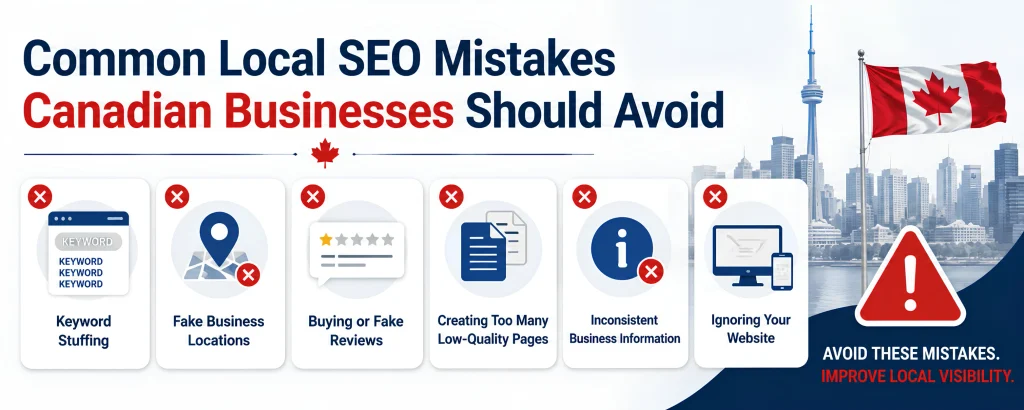
Common Local SEO Mistakes Canadian Businesses Should Avoid
Local SEO can become less effective when businesses focus on shortcuts instead of building a reliable online presence.
Some common mistakes include:
Keyword Stuffing
Repeating “best plumber Toronto” throughout a page does not make the content better.
Write naturally.
Fake Locations
Don’t create fake business addresses just to target cities where you don’t actually operate.
Buying Reviews
Fake reviews can damage trust and create long-term problems.
Creating Hundreds of Low-Quality Pages
Creating a separate page for every neighbourhood with nearly identical content isn’t a strong strategy.
Ignoring the Website
Your Google Business Profile matters, but your website still plays an important role in explaining your services and converting visitors.
Focusing Only on Rankings
A ranking is useful, but it isn’t the final goal.
The real question is: Are more customers calling, booking and contacting your business?
How to Measure Local SEO Success
A good local SEO campaign should be measured using more than rankings.
Important metrics can include:
- Google Business Profile interactions
- Website traffic from local searches
- Phone calls
- Contact form submissions
- Appointment bookings
- Quote requests
- Direction requests
- Organic traffic
- Local keyword visibility
- Conversion rate
- Leads generated
- Cost per lead
For a local service business, 20 additional qualified enquiries may be more valuable than thousands of visitors who never become customers.
That’s why local SEO should be connected to business results.
Is Local SEO Worth It for Canadian Small Businesses?
For businesses that depend on customers from a specific geographic area, local SEO can be one of the most practical long-term digital marketing investments.
It helps connect your business with people who are actively searching for the products or services you provide.
Instead of paying to show your business to everyone, local SEO helps you build visibility around the locations and services that matter to your company.
It can support:
- More local visibility
- More website visitors
- More calls
- More enquiries
- More bookings
- Better brand recognition
- Stronger online reputation
- Greater competitiveness in your local market
Most importantly, it can help your business become easier to find when a customer is ready to take action.
Frequently Asked Questions
What is local SEO?
Local SEO is the process of improving a business’s online presence so it can appear in searches related to its location, services and local customers.
Why is local SEO important for Canadian businesses?
It helps businesses reach customers searching for products and services in their local area. This is particularly valuable for businesses that serve specific cities, communities or service areas.
How do I rank higher on Google Maps?
Start by verifying and fully completing your Google Business Profile. Keep your information accurate, use relevant categories and services, earn genuine customer reviews and strengthen your website and overall online presence. Google identifies relevance, distance and prominence as the main factors behind local ranking.
Does local SEO help generate leads?
Yes. Local SEO can bring your business in front of people actively searching for your services, which can lead to phone calls, enquiries, bookings, visits and quote requests.
How important are Google reviews for local SEO?
Reviews can contribute to a business’s prominence in local search and strongly influence customer trust. Google specifically notes that reviews and positive ratings can help a business’s local ranking.
Do small businesses need local SEO?
If your customers are primarily located in a specific city, region or service area, local SEO can be highly valuable. It allows a smaller business to compete for relevant local searches instead of trying to compete nationally.
How long does local SEO take?
Results vary depending on competition, location, website authority, existing online presence and the amount of work being done. Local SEO generally requires ongoing optimisation rather than a one-time setup.
Is local SEO different from traditional SEO?
Yes. Traditional SEO often focuses on broader organic search visibility, while local SEO places greater emphasis on geographic relevance, Google Business Profile visibility, local searches, reviews, citations and location-specific content.
Final Thought
Canadian customers are already searching online for businesses, services and products in their communities. The opportunity is not simply to get your website in front of more people.
It’s to make sure your business appears when the right local customer is looking for what you offer.
A strong local SEO strategy brings together your Google Business Profile, website, reviews, local content, citations, technical SEO and online reputation.
Google’s own guidance makes it clear that relevance, distance and prominence play central roles in local rankings.
You can’t control everything — particularly where a customer is searching from — but you can make your business easier for Google to understand and easier for customers to trust.
For a Canadian small business, that can mean the difference between being overlooked in local search and becoming the business a customer chooses to call.
WordPress vs Shopify: Which Platform Is Best for Canadian Businesses?
Digital Marketing Trends Every Canadian Business Should Watch in 2026