Having a website does not automatically mean your business will appear when potential customers search on Google.
Many Canadian businesses invest in a professional website, publish a few blog posts, create a Google Business Profile, and then wonder why competitors continue to appear above them. In most cases, the problem is not that SEO does not work. The problem is that important parts of the SEO foundation are missing, poorly implemented, or simply ignored.
For a small business, this can have a direct impact on leads and sales. If your competitors appear when someone searches for your services, they get the opportunity to earn that customer before you even enter the conversation.
Google explains that SEO helps search engines understand your content and helps users discover your website through search. However, there is no single trick that guarantees a first-place ranking. Google evaluates many signals related to relevance, content, accessibility, technical quality, and the overall experience a page provides.
For Canadian businesses, there is another important consideration: local search. A company competing for customers in Toronto, Calgary, Vancouver, Edmonton, Ottawa, Halifax, Winnipeg, Montréal, or another Canadian market needs to make its location and service relevance clear without creating low-quality, repetitive pages.
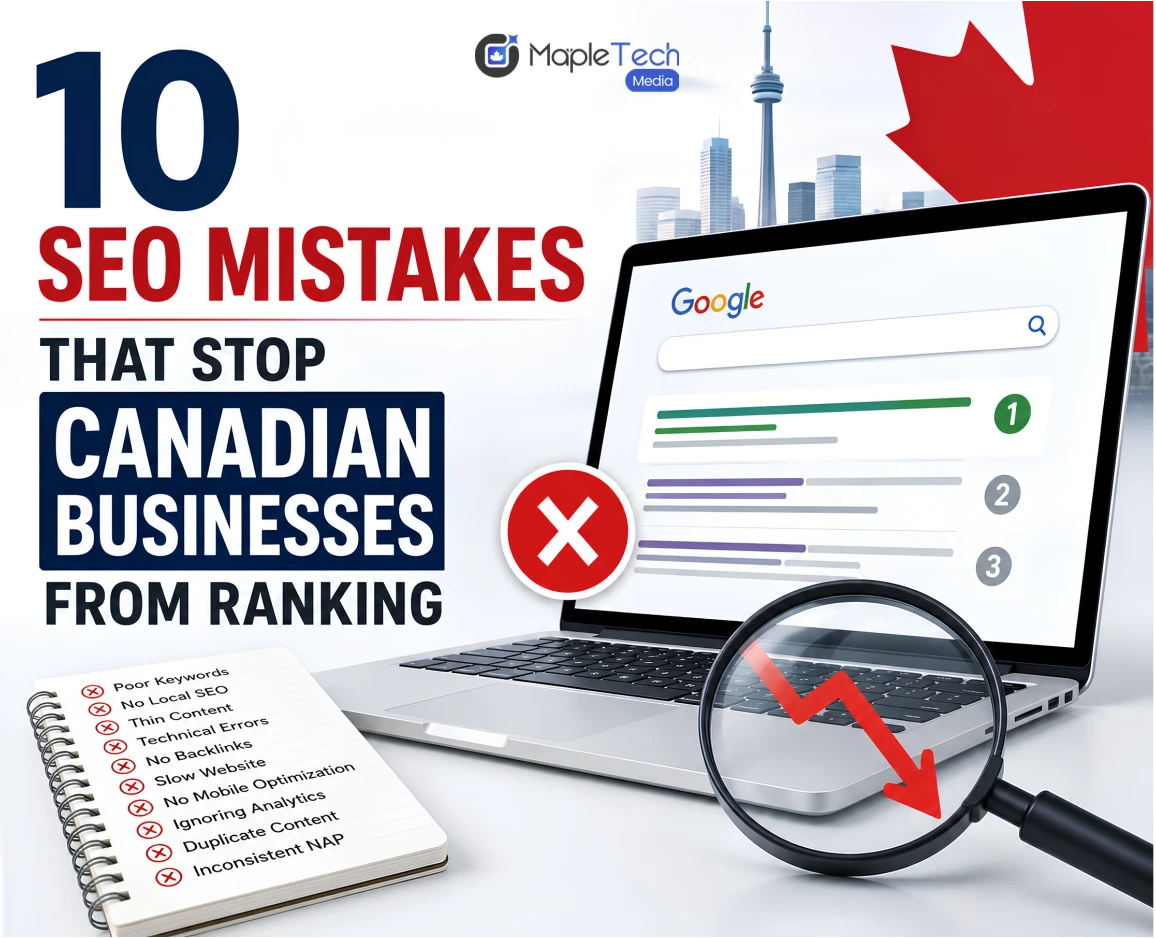
Here are 10 common SEO mistakes that can hold a Canadian business website back and what you can do about them.
Table of Contents
1. Targeting the Wrong Keywords
One of the most common SEO mistakes Canadian businesses make is choosing keywords based on what they think people search for rather than what their potential customers actually use.
For example, a Toronto landscaping company might decide that it wants to rank for:
“landscaping”
That sounds like a valuable keyword, but it is extremely broad. The person searching it could be looking for landscaping ideas, landscaping companies, landscaping courses, equipment, or something completely different.
A better strategy may involve more specific searches such as:
- landscaping company Toronto
- residential landscaping Toronto
- backyard landscaping services Toronto
- lawn maintenance Toronto
- commercial landscaping services Toronto
The goal is not simply to find keywords with large search volumes. The goal is to find keywords that match your services and the customer’s intent.
How to fix it
Start by identifying:
- What services you actually provide.
- What problems your customers want solved.
- Where your customers are located.
- Whether the searcher is looking for information, a service, a product, or a company.
- Which searches are most likely to generate a lead or sale.
Then build your website around meaningful keyword groups rather than trying to make one page rank for everything.
Google also recommends thinking about the different words users may use when searching for the same information instead of obsessing over one exact keyword phrase.
2. Ignoring Search Intent
Finding the right keyword is only half the job. You also need to understand why someone is searching for it.
Imagine someone searches:
“How much does a roof replacement cost in Canada?”
They are probably looking for information.
Someone searching:
“roof replacement company Calgary”
is much closer to hiring a service provider.
If you create a generic blog post when the searcher is looking for a service page or create a sales page when they are looking for educational information the page may not satisfy the search intent.
How to fix it
Before creating a page, search the keyword yourself.
Look at the types of pages appearing in Google:
- Are they service pages?
- Blog articles?
- Product pages?
- Location pages?
- Guides?
- Comparison pages?
The search results provide a useful indication of what Google believes satisfies that query.
Your page should provide a better, clearer answer to the same intent rather than simply repeating the keyword.
3. Treating Local SEO as Optional
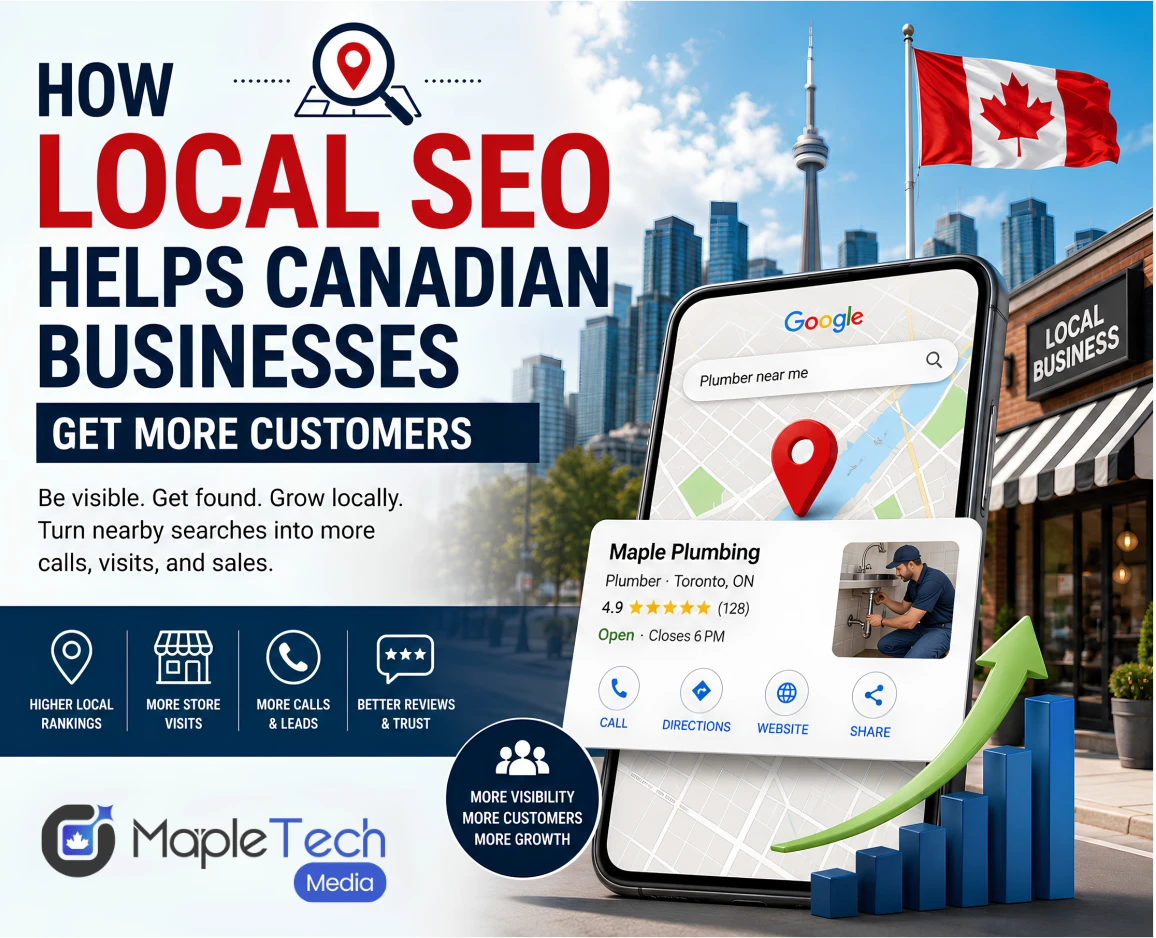
If your business serves customers in a specific city or region, local SEO should be part of your strategy.
A Toronto plumber, Calgary dentist, Vancouver law firm, Ottawa contractor, or Montreal marketing agency does not need to compete equally for every search across Canada.
The objective is to become visible for searches relevant to the locations and customers you actually serve.
Local SEO can involve:
- Your Google Business Profile
- Location information on your website
- Service-area information
- Relevant local content
- Consistent business information
- Customer reviews
- Local citations
- Relevant links from other websites
- Properly structured service and location pages
Canadian SEO agencies and industry studies continue to identify incomplete local profiles, inconsistent business information, weak local content, and neglected local signals as recurring problems.
How to fix it
Make sure your business information is accurate and consistent.
Your business name, address, phone number, website, hours, services, and service areas should be kept up to date wherever customers and search engines may encounter them.
Most importantly, do not create dozens of almost identical location pages simply by replacing the city name.
A useful location page should contain genuinely relevant information about serving that market.
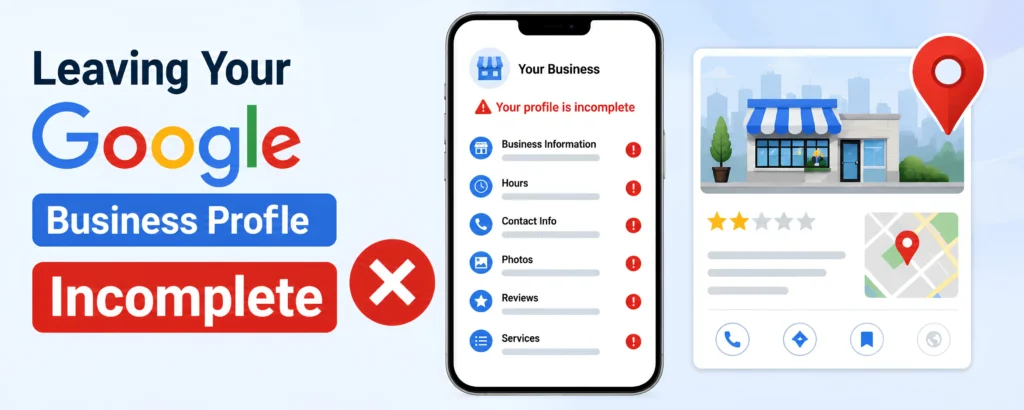
4. Leaving Your Google Business Profile Incomplete
For businesses that depend on local customers, your Google Business Profile is an important part of your online presence.
Yet many businesses claim their profile and then barely touch it.
Common problems include:
- Incorrect primary category
- Missing secondary categories
- Incomplete business information
- Outdated opening hours
- Missing services
- Poor-quality photos
- Unanswered customer reviews
- Old business information
- Incorrect service areas
An incomplete profile gives potential customers less information and can make it harder for Google to understand the business.
How to fix it
Review your profile carefully.
Make sure your:
- Business name is accurate.
- Primary category accurately represents the business.
- Services are properly listed.
- Hours are current.
- Website URL is correct.
- Phone number is correct.
- Address or service area is accurate.
- Photos represent the real business.
- Customer reviews receive appropriate responses.
Do not treat the profile as something you set up once and forget.
5. Publishing Thin or Generic Content
Adding more pages does not automatically improve SEO.
A website with 100 weak pages is not necessarily stronger than a website with 30 genuinely useful pages.
Thin content can happen when businesses:
- Rewrite information found on competitors’ websites.
- Publish very short articles that provide little value.
- Create dozens of nearly identical location pages.
- Produce content only because a keyword has been identified.
- Publish generic AI-generated articles without adding real expertise.
- Create blog posts that do not answer the customer’s actual question.
Google’s current guidance is clear that content should be created primarily for people, provide useful information, demonstrate appropriate expertise, and give readers a satisfying answer. Google also specifically warns against producing large amounts of content mainly to attract search traffic or simply summarizing what other websites have already said.
How to fix it
Before publishing an article, ask:
“Would this still be useful if Google did not exist?”
If the answer is no, the content probably needs more work.
Add practical information, examples, original explanations, relevant data, useful steps, and answers to the questions your customers actually ask.
Quality matters more than publishing volume.
6. Ignoring Technical SEO
You can have excellent content and still have SEO problems if search engines cannot properly access, crawl, understand, or index your website.
Technical SEO can include:
- Crawlability
- Indexing
- Robots.txt
- XML sitemaps
- Canonical URLs
- Redirects
- Broken links
- Duplicate pages
- Page structure
- JavaScript rendering
- Website security
- Mobile accessibility
- Page performance
Google explains that Search involves three major stages: crawling, indexing, and serving search results. Problems during crawling or indexing can prevent pages from being properly understood or served in search.
How to fix it
Regularly check your website through Google Search Console.
Look for:
- Pages that are not indexed.
- Unexpected indexing issues.
- Server errors.
- Mobile problems.
- Core Web Vitals issues.
- Sitemap problems.
- Pages Google cannot access.
A sitemap can help Google discover pages, but it does not guarantee that those pages will be indexed or rank.
Technical SEO should be treated as part of ongoing website maintenance, not something you only check when rankings suddenly fall.
7. Having a Poor Mobile Experience
A website can look excellent on a desktop computer and still provide a frustrating experience on a phone.
That matters because Google uses the mobile version of a site’s content for indexing and ranking under mobile-first indexing.
Common mobile problems include:
- Text that is difficult to read.
- Buttons that are too small.
- Slow-loading pages.
- Menus that are difficult to use.
- Images that are too large.
- Content missing from mobile.
- Forms that are difficult to complete.
- Pop-ups covering important information.
For a local business, this can be particularly damaging because many people search for services while using a mobile device and may want to call, request directions, or submit an enquiry immediately.
How to fix it
Test your important pages on an actual phone.
Check:
- Can visitors read everything without zooming?
- Can they easily navigate the menu?
- Can they call you?
- Can they complete your contact form?
- Does the page load quickly?
- Is the main content available on mobile?
Google recommends responsive web design and advises ensuring that the mobile version contains the same important content as the desktop version.
8. Poor Internal Linking and Website Structure
Internal links are often overlooked because they do not feel as exciting as backlinks or keyword research.
But they help both users and search engines understand how your website is organised.
For example, suppose a Canadian accounting firm has separate pages for:
- Personal tax services
- Corporate tax services
- Bookkeeping
- Payroll
- Tax planning
Those pages should not exist as isolated URLs.
Relevant pages should connect naturally to one another.
A blog article about small-business tax planning could link to the firm’s corporate tax service page. A bookkeeping article could link to the bookkeeping service page.
How to fix it
Review your website and ask:
- Can users easily move from an article to the relevant service?
- Are your important pages linked from other relevant pages?
- Do your links use clear, descriptive anchor text?
- Are there important pages that receive almost no internal links?
- Does your navigation reflect the actual structure of the business?
Google recommends making links crawlable so its systems can discover other pages on your website.
Good internal linking also helps users find the next useful piece of information instead of reaching a dead end.
9. Building Low-Quality Backlinks
Backlinks can help establish a website’s authority, but chasing links without considering quality can create more problems than benefits.
Some businesses still purchase large quantities of cheap backlinks because a provider promises hundreds or thousands of links.
That is not a sensible long-term SEO strategy.
Potential problems include:
- Spammy directories
- Irrelevant websites
- Paid link schemes
- Automated link networks
- Low-quality guest posts
- Links from unrelated industries
- Excessive exact-match anchor text
The objective should not be:
“How many backlinks can we get?”
A better question is:
“Can we earn links from websites that are genuinely relevant and trustworthy?”
How to fix it
For a Canadian business, consider legitimate opportunities such as:
- Industry associations
- Local business organisations
- Canadian publications
- Community organisations
- Relevant suppliers and partners
- Sponsorships
- Local events
- Professional associations
- Digital PR
- Useful original research
A good local link is often more valuable strategically than a large number of irrelevant links.
10. Treating SEO as a One-Time Project
This is one of the biggest mistakes businesses make.
SEO is not:
“Optimise the website once and wait for Google.”
Search results change. Competitors publish new pages. Businesses add services. Websites are redesigned. Technical problems appear. Search behaviour changes.
That means SEO needs ongoing attention.
Google itself notes that changes can take anywhere from hours to months to be reflected in search results, depending on the change and other factors.
How to fix it
Create an ongoing SEO process.
Every month, review:
- Organic traffic
- Search impressions
- Click-through rate
- Ranking keywords
- Important landing pages
- Google Search Console data
- Leads from organic search
- Local visibility
- Google Business Profile activity
- New competitors
- Technical problems
- Content opportunities
Do not judge SEO only by whether one keyword moved from position 12 to position 8.
The real question is whether organic search is bringing relevant visitors, enquiries, phone calls, bookings, purchases, or other business results.
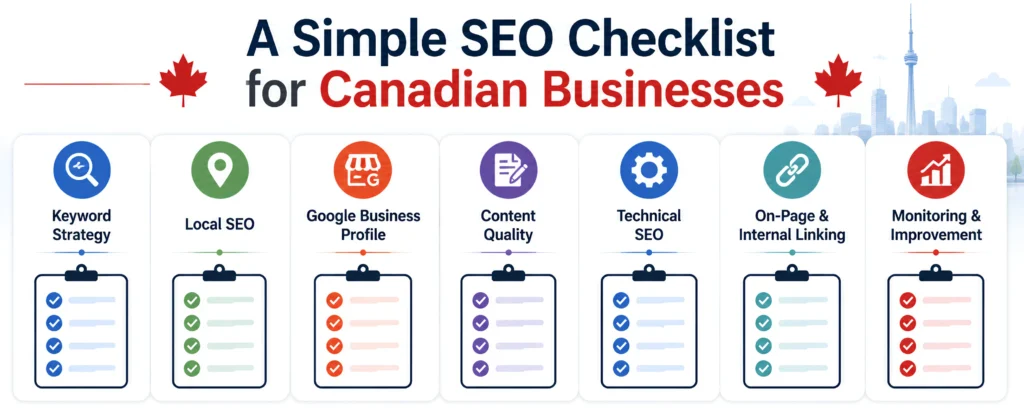
A Simple SEO Checklist for Canadian Businesses
If you are not sure where your website currently stands, start with these questions.
Keyword strategy
- Are you targeting keywords your customers actually search?
- Do your keywords match your services?
- Are you considering search intent?
- Are you targeting realistic local and national terms?
Website
- Does every important service have a dedicated page?
- Is your website easy to navigate?
- Is it mobile-friendly?
- Does it load efficiently?
- Are important pages indexed?
Local SEO
- Is your Google Business Profile complete?
- Is your primary category accurate?
- Are your business details consistent?
- Are your reviews being managed?
- Does your website clearly explain where you serve customers?
Content
- Does your content answer real customer questions?
- Is it original?
- Is it specific to your audience?
- Does it demonstrate real knowledge?
- Are you avoiding repetitive location pages?
Technical SEO
- Is your website crawlable?
- Are important pages indexable?
- Are there broken links?
- Are canonical tags working correctly?
- Is your XML sitemap healthy?
- Are there unexpected redirects or duplicate pages?
Authority
- Are you earning relevant backlinks?
- Are you listed with legitimate industry organisations?
- Do reputable Canadian websites mention your business?
- Are you avoiding spammy link-building packages?
How Long Does It Take to Fix SEO Mistakes?
There is no universal timeline.
Some problems can be fixed immediately. For example, correcting a broken title tag or fixing an incorrect business phone number may take minutes.
Other problems take considerably longer.
Improving:
- Website authority
- Content quality
- Local visibility
- Backlink profile
- Competitive keyword rankings
- Topical coverage
can require months of consistent work.
It is also important to understand that fixing an SEO problem does not guarantee a specific ranking position. Google does not guarantee that a website will be crawled, indexed, or rank simply because it follows SEO best practices.
The right approach is to fix the highest-impact problems first and then measure the results.
- SEO services in Canada
- Website development services in Canada
- Digital marketing company in Canada
- Custom shopify development services in Canada
What Should Canadian Businesses Do First?
If your website is not ranking, do not immediately start publishing 20 new blog posts.
Start with an audit.
Step 1: Check indexing
Make sure Google can find and index your important pages.
Step 2: Review your service pages
Make sure each important service has a useful, dedicated page that matches customer intent.
Step 3: Review your keyword targeting
Make sure you’re targeting realistic searches rather than chasing broad keywords simply because they have high search volume.
Step 4: Fix technical problems
Check crawlability, indexing, mobile performance, broken links, redirects, duplicate pages and other technical issues.
Step 5: Improve local SEO
If you serve a specific area, review your Google Business Profile, local information, reviews and location relevance.
Step 6: Improve existing content
Before creating dozens of new articles, improve pages that already have impressions but are not getting enough clicks or rankings.
Step 7: Build genuine authority
Earn relevant mentions and links through useful content, partnerships, industry organisations, community involvement and legitimate PR.
Step 8: Measure business outcomes
Track leads and conversions, not just keyword positions.
Frequently Asked Questions
1. Why is my Canadian business website not ranking on Google?
Common reasons include targeting the wrong keywords, weak or thin content, technical SEO problems, poor local SEO, weak internal linking, and a lack of quality backlinks. An SEO audit can help identify the specific issues affecting your rankings.
2. What are the most common SEO mistakes Canadian businesses make?
Some of the most common mistakes are targeting broad keywords, ignoring search intent, neglecting Google Business Profile optimization, publishing generic content, overlooking technical SEO, and treating SEO as a one-time task.
3. Does Google Business Profile affect local SEO in Canada?
Yes. A complete and accurate Google Business Profile can help Google understand your business and match it with relevant local searches. Business information such as your category, hours, address or service area, and other profile details should be kept accurate and up to date.
4. How long does it take to fix SEO mistakes and improve Google rankings?
There is no fixed timeline. Results depend on the website’s current condition, competition, industry, content quality, and the extent of the SEO problems. Some technical improvements can have an impact relatively quickly, while stronger organic visibility usually takes ongoing work.
5. How can a small business improve its Google ranking in Canada?
Start with a technical SEO audit, research relevant keywords, improve important service pages, create useful Canadian-focused content, optimize your Google Business Profile, strengthen internal linking, earn quality backlinks, and regularly monitor your SEO performance.
6. What should I fix first if my website is not ranking?
Start by checking whether your important pages can be crawled and indexed. Then review your keyword targeting, search intent, on-page content, technical issues, mobile experience, internal links, and local SEO signals. Google recommends maintaining useful, accurate, and complete business information for local visibility.
7. Is SEO a one-time project for Canadian businesses
No. SEO should be treated as an ongoing process. Search behaviour, competitors, websites, content, and Google’s systems change over time, so businesses should continue monitoring performance and improving their website.
8. Can SEO mistakes reduce local customers and leads?
Yes. Problems such as inaccurate business information, an incomplete Google Business Profile, poor local targeting, or weak website content can make it harder for potential customers to find and evaluate your business in local search.
Final Thoughts
SEO problems rarely come from one single mistake.
A Canadian business may have good content but weak technical SEO. Another may have a technically sound website but poor keyword targeting. A local company may have excellent services but an incomplete Google Business Profile. Another may publish constantly but never create content that actually answers what customers are searching for.
The important thing is to find the problems that are holding the website back and fix them in the right order.
The foundation is simple:
- Choose the right keywords.
- Match search intent.
- Create useful content.
- Build a technically healthy website.
- Strengthen local visibility where it matters.
- Earn relevant authority.
- Keep measuring and improving.
Google’s own guidance consistently puts the emphasis on useful, reliable, people-first content and a website that can be properly crawled, understood and used.
For Canadian businesses, the goal should not simply be to “do SEO.” The goal is to become easier to find when the right Canadian customer is actively looking for what you offer.
If you are unsure why your website is not ranking, an SEO audit can help identify the technical, content, keyword and local SEO issues that need attention.
MapleTech Media helps Canadian businesses improve their online visibility through SEO, website development, content marketing and digital marketing strategies built around real business goals not just rankings.
How Much Does Website Development Cost in Canada?
How Local SEO Helps Canadian Businesses Get More Customers
WordPress vs Shopify: Which Platform Is Best for Canadian Businesses?
Digital Marketing Trends Every Canadian Business Should Watch in 2026