If you are planning to build a new website for your Canadian business, one of the first questions you will probably ask is: How much will it cost?
The frustrating answer is that there is no single price.
A simple website for a local service business can cost a few thousand dollars, while an ecommerce store, custom business platform or web application can cost tens of thousands. You may also find website offers for a few hundred dollars, or even free website builders, which makes comparing prices even more confusing.
The important thing is to understand what you are actually paying for.
A website is not simply a collection of pages. It can include strategy, design, development, content, SEO, ecommerce functionality, integrations, security, hosting, maintenance and ongoing support.
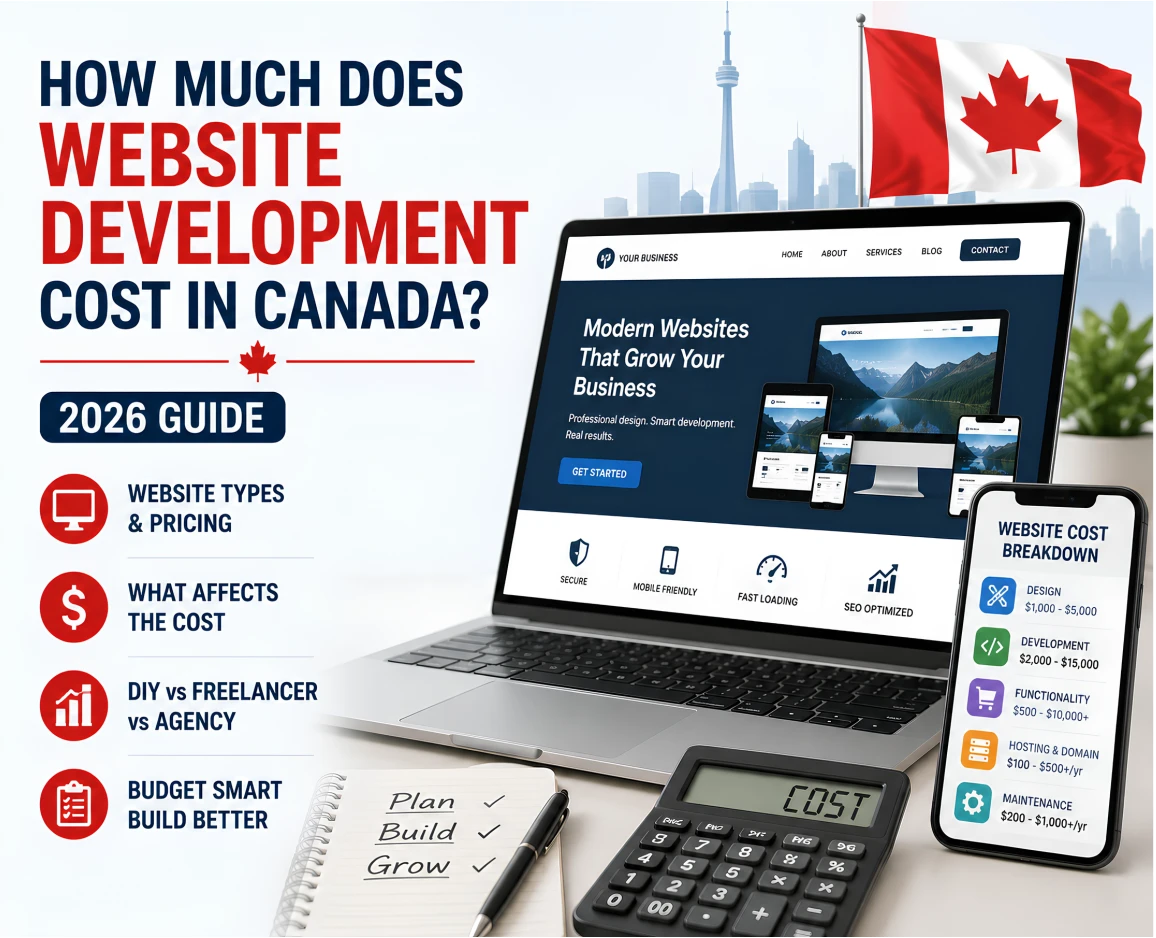
For Canadian businesses in 2026, professional small-business websites commonly fall somewhere in the $3,000 to $15,000+ CAD range, depending on the project. More advanced ecommerce websites and custom platforms can move considerably higher. Current Canadian market guides show similarly broad ranges, which reflects differences in scope rather than one fixed industry price.
So, what should you actually budget?
Let’s break it down.
Website Cost in Canada
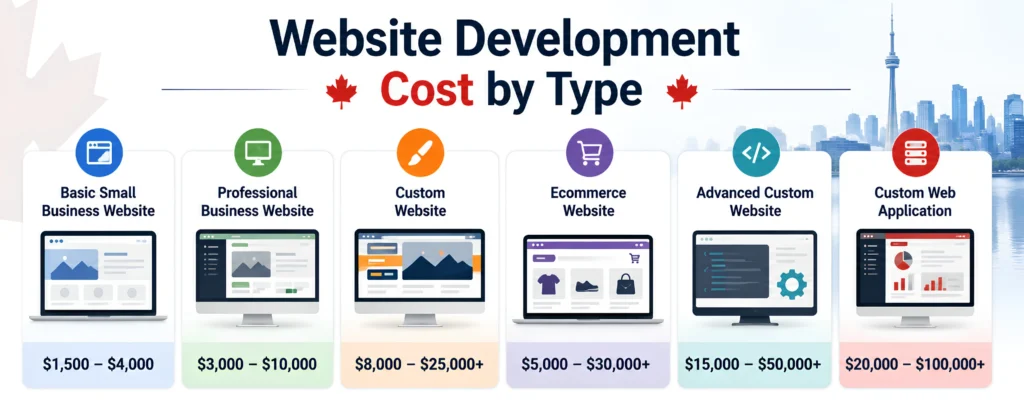
Here is a practical starting point for Canadian businesses:
| Website Type | Approximate Cost in Canada |
| DIY website builder | $200–$1,000+ per year |
| Basic small business website | $1,500–$4,000 |
| Professional business website | $3,000–$10,000 |
| Custom-designed website | $8,000–$25,000+ |
| Ecommerce website | $5,000–$30,000+ |
| Advanced custom website | $15,000–$50,000+ |
| Custom web application | $20,000–$100,000+ |
These figures are planning ranges, not fixed Canadian industry rates. The final quote depends on the number of pages, design requirements, content, functionality, integrations, platform, SEO requirements and who is developing the website.
For example, a five-page website for a local electrician is a very different project from a Shopify store with hundreds of products, payment integrations and inventory management.
That’s why two businesses can receive completely different website development quotes and both quotes can be reasonable.
Table of Contents
What Is Included in Website Development?
Before comparing prices, it helps to understand what website development actually involves.
Depending on the project, website development can include:
- Website planning and strategy
- Sitemap development
- UX and user journey planning
- Website design
- Mobile-responsive development
- Content management system setup
- Website content
- Contact forms
- Booking functionality
- Ecommerce functionality
- Payment integration
- Third-party integrations
- Search engine optimisation
- Analytics setup
- Security configuration
- Website testing
- Launch and deployment
- Training
- Ongoing maintenance
A cheaper quote may include only the basic website build, while a more comprehensive package may include many of these services.
This is why comparing the final price without comparing the scope can be misleading.
Website Development Cost by Type
Different websites require different levels of planning and development.
1. Basic Small Business Website: $1,500–$4,000
A basic website can be suitable for a small Canadian business that mainly needs a professional online presence.
For example, a local:
- Plumber
- Contractor
- Cleaning company
- Consultant
- Photographer
- Accountant
- Landscaper
- Home service provider
may only need five to eight well-structured pages.
A typical website could include:
- Home
- About
- Services
- Individual service pages
- Contact
- FAQ
- Testimonials
The goal is usually straightforward: explain what the business does, establish trust and make it easy for potential customers to get in touch.
A basic website can be perfectly effective when it is planned properly. The mistake is assuming that “basic” should mean poorly designed or difficult to use.
2. Professional Business Website: $3,000–$10,000
An established business may need more than a basic online brochure.
A professional website may include custom design, stronger content, multiple service pages, lead-generation features, SEO foundations, integrations and a more carefully planned customer journey.
This type of website is often a good fit for Canadian small and medium-sized businesses that want their website to actively support sales.
For example, instead of having one generic “Services” page, the website could have dedicated pages for:
- Residential Roofing
- Commercial Roofing
- Roof Repairs
- Roof Replacement
- Emergency Roofing
Each page can target a specific service and customer need.
That creates a much stronger foundation for both users and search engines.
Google’s own developer guidance recommends making websites easy for search engines to crawl and understand, while also ensuring they are secure, fast, accessible and functional across devices.
3. Custom Website: $8,000–$25,000+
Custom website development becomes more expensive because more of the project is built around the individual business rather than simply adapting an existing template.
A custom website may involve:
- Original UI/UX design
- Custom page layouts
- Advanced forms
- Membership areas
- Customer portals
- Custom calculators
- API integrations
- CRM integration
- Appointment systems
- Advanced search
- Custom dashboards
- Special business workflows
At this point, the website starts functioning more like a business tool than a digital brochure.
The value is not necessarily in having more pages. It is in having functionality that solves a specific business problem.
How Much Does an Ecommerce Website Cost in Canada?
Ecommerce websites generally cost more because they need to handle transactions and customer accounts, products, payments and other operational requirements.
A Canadian ecommerce website may cost approximately $5,000 to $30,000+, depending on its size and complexity. Current Canadian guides show ecommerce pricing spanning a wide range for exactly this reason.
Costs can increase when you need:
- Hundreds or thousands of products
- Product variations
- Online payments
- Shipping calculations
- Tax configuration
- Inventory management
- Customer accounts
- Discount codes
- Abandoned-cart functionality
- Email automation
- Accounting integration
- CRM integration
- Marketplace integration
- Custom checkout functionality
A small online store with 20 products does not have the same development requirements as a retailer managing thousands of products across multiple sales channels.
Canada’s ecommerce market also represents a meaningful opportunity for businesses. Statistics Canada reported that 32% of Canadian businesses received e-commerce orders in 2023, while total e-commerce sales across the economy reached $347 billion.
How Much Does a WordPress Website Cost in Canada?
WordPress remains a popular option for businesses that want flexibility and control over their website.
The cost can vary considerably.
A relatively straightforward WordPress website may fall around $1,500–$5,000, while a professionally designed or highly customised WordPress project can reach $10,000 or more.
The price depends on factors such as:
- Theme or custom design
- Number of pages
- Plugins
- Custom development
- Ecommerce requirements
- Booking systems
- SEO
- Content
- Integrations
- Security
- Maintenance
One advantage of WordPress is that businesses can start with a manageable website and expand it over time.
However, choosing WordPress does not automatically make a website cheap. A professionally planned WordPress website still requires design, development, testing and ongoing management.
How Much Does a Shopify Website Cost in Canada?
Shopify is another popular choice, particularly for businesses that want to sell products online.
The development cost depends on whether you use:
- A standard Shopify theme
- A customised theme
- A premium theme
- A fully custom Shopify design
- Custom apps
- Third-party integrations
A straightforward Shopify store may cost several thousand dollars to set up, while a larger custom ecommerce project can reach $10,000, $20,000 or considerably more.
There are also ongoing platform and app costs to consider.
That means the development quote is only part of the overall Shopify budget.
What Factors Affect Website Development Cost in Canada?
If you receive three different website quotes, don’t immediately assume the most expensive one is overcharging you.
There may be significant differences in what each company is actually providing.
Here are some of the biggest factors affecting website development cost.
1. Number of Pages
More pages generally mean more planning, design, development and content.
A five-page website is much simpler than a 30-page website with individual service and location pages.
However, page count should not be the only consideration.
Ten well-planned pages can be more valuable than 30 pages created simply to make the website look bigger.
2. Website Design
You can use a ready-made template, customise an existing theme or create a completely original design.
Custom design usually costs more because it requires additional research, UX planning, design work and development.
The right approach depends on your business and budget.
A new local business may not need a $20,000 design project on day one.
3. Content
Who is writing the website?
If you provide all the content, development costs may be lower.
If your developer or agency handles:
- Website copy
- Service descriptions
- Product descriptions
- Blog content
- Images
- Graphics
- Video
The project budget will increase. Good content is worth budgeting for because your website needs to communicate clearly before it can convince someone to contact you.
4. SEO
SEO should not be treated as something you add after the website is finished.
A search-friendly website needs a sensible structure from the beginning.
This can include:
- Keyword research
- Page structure
- SEO-friendly URLs
- Metadata
- Internal linking
- Heading structure
- Image optimisation
- Technical SEO
- Schema markup where appropriate
- Search Console setup
- Analytics
Google notes that SEO can help relevant users discover a website through Search and recommends making websites easy to crawl, understand and use.
5. Custom Functionality
The more a website needs to do, the more development work is involved.
A simple contact form is inexpensive compared with a custom booking system that connects to another platform.
Similarly, displaying products is easier than building an inventory system connected to accounting software, shipping providers and multiple sales channels.
6. Integrations
Businesses often need their website to communicate with other software.
Examples include:
- CRM systems
- Email marketing platforms
- Accounting software
- Payment gateways
- Booking software
- Shipping platforms
- Marketing automation
- Customer databases
Every integration adds development and testing requirements.
7. Mobile Optimisation
A modern website needs to work properly on phones and tablets, not just desktop computers.
This means layouts, buttons, forms, images, navigation and content need to be tested across different screen sizes.
Mobile optimisation is not a luxury feature. It is part of building a usable modern website.
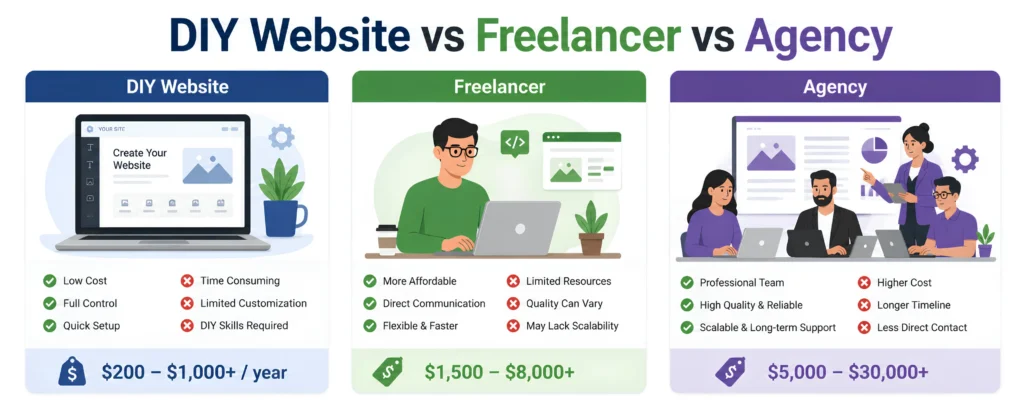
DIY Website vs Freelancer vs Agency
One of the biggest decisions you’ll make is who should build the website?
DIY Website Builder
Cost: approximately $200–$1,000+ per year, depending on the platform and extras.
This option can work for:
- Very small businesses
- Early-stage startups
- Personal projects
- Temporary websites
- Businesses with extremely limited budgets
The downside is that you are responsible for the work. Your time has a cost too.
Freelancer
Cost: commonly $1,500–$8,000+, depending on experience and project scope.
A freelancer can be a good choice for a relatively straightforward project.
You may get direct communication with the person building the website, which can make smaller projects easier to manage.
The quality and level of service can vary significantly, so review previous work carefully.
Web Development Agency
Cost: commonly $5,000–$30,000+, depending on the agency and project.
An agency may bring together several areas of expertise, such as:
- Strategy
- Design
- Development
- SEO
- Copywriting
- Branding
- Project management
- Marketing
For businesses that want their website to become an important part of their marketing strategy, this broader expertise can be valuable.
The right choice depends on your project — not simply your budget.
What Are the Ongoing Costs of Owning a Website?
One common mistake is budgeting only for development. Your website may also have ongoing expenses.
Domain
Your domain name normally requires annual renewal.
Hosting
Your website needs somewhere to live. Hosting costs vary depending on the platform, traffic and technical requirements.
Maintenance
Websites need updates, backups, security monitoring and occasional fixes.
Plugins and Apps
Some platforms require paid plugins or apps for additional functionality.
Content
Your business may continue investing in new pages, blogs, product descriptions, images or other content.
SEO
If you want to compete consistently in organic search, SEO is usually an ongoing process rather than a one-time website task.
Website Support
Some businesses prefer to have someone available when they need updates, troubleshooting or technical changes.
These expenses can range from relatively small annual costs to several thousand dollars per year for a business requiring regular support.
What Should a Small Business Budget for a Website?
For many Canadian small businesses, a practical starting budget is around $3,000–$10,000 for a professionally built website.
That doesn’t mean every business should spend that much.
A new business with a simple service offering may be perfectly comfortable with a smaller project.
An established business generating substantial leads through its website may benefit from investing more heavily in strategy, content, SEO, conversion optimisation and custom functionality.
The question shouldn’t be:
“What is the cheapest website I can get?”
A better question is:
“What website do I need to support my business goals?”
If your website brings in customers, books appointments or generates qualified leads, the value of the website should be considered alongside its development cost.
How to Avoid Overpaying for Website Development
Getting a low price isn’t necessarily the same as getting good value. Before accepting a quote, ask exactly what is included.
Ask about:
- Number of pages
- Design process
- Mobile optimisation
- Content
- SEO
- Hosting
- Domain
- Security
- Analytics
- Forms
- Integrations
- Revisions
- Training
- Maintenance
- Post-launch support
Also ask what isn’t included.
This is important because a $3,000 quote may become a $6,000 project if important features were excluded from the original scope.
A clear proposal should explain the deliverables, responsibilities, timeline and additional costs before development begins.
Red Flags in a Website Development Quote
Be cautious if a provider:
- Gives a price without asking about your business
- Cannot explain what the quote includes
- Promises instant Google rankings
- Uses vague descriptions such as “complete SEO” without details
- Has no clear revision process
- Doesn’t explain ownership of the website
- Offers extremely low pricing with no scope
- Doesn’t discuss mobile performance
- Cannot show relevant previous work
- Has no post-launch support plan
A professional website proposal should make the project easier to understand, not more confusing.
Should You Spend More on Your Website?
Not necessarily.
More expensive does not automatically mean better.
A $25,000 website can be a poor investment if the business only needed a simple lead-generation website.
Likewise, a $3,000 website can be a poor investment if the business needs advanced ecommerce, custom integrations and a complex customer portal.
The goal is to match the website investment to the business requirement. Think about what the website needs to accomplish.
- Do you need more phone calls?
- More quote requests?
- Online bookings?
- Product sales?
- Better visibility in Google?
- A stronger professional image?
- A customer portal?
Once the goal is clear, it becomes much easier to determine how much development work is actually necessary.
Website Development Cost vs Website Value
It is easy to look at a website as an expense.
But for many businesses, it is better viewed as part of the sales and marketing infrastructure.
Imagine a local Canadian service company receives just five additional qualified enquiries every month because its website is easier to find and easier to use.
If even a portion of those enquiries become customers, the website may generate considerably more value than its original development cost.
This is why design, SEO, messaging, speed and conversion paths matter. A website should not simply look good. It should help people take the next step.
What Should Be Included in a Professional Website Package?
For a typical Canadian small-business website, I would look for a package that covers the fundamentals:
- Custom or carefully customised design
- Mobile-responsive development
- Clear website structure
- Professional page layouts
- Contact and lead forms
- Basic technical SEO
- Metadata setup
- Image optimisation
- Analytics
- Search Console
- Security
- Website testing
- Launch support
Depending on your business, you may also need:
- Local SEO
- Ecommerce
- Booking functionality
- CRM integration
- Copywriting
- Professional photography
- Custom graphics
- Blog setup
- Ongoing SEO
- Maintenance
The important thing is that the package should be built around your business requirements rather than a generic list of features.
How Long Does Website Development Take in Canada?
The development timeline depends on the size and complexity of the project.
A simple website may take a few weeks. A larger business website may take several weeks to a few months. An ecommerce store or custom platform can take considerably longer.
Delays often happen because of:
- Late content
- Slow approvals
- Design changes
- Additional functionality
- Third-party integrations
- Product uploads
- Scope changes
A good development process should establish milestones and responsibilities before work begins.
Is Website Development Worth the Investment for a Canadian Business?
For most businesses that depend on online visibility, enquiries or sales, a professional website can be a worthwhile investment.
But the website itself is not magic. A good website needs to be supported by the right strategy.
That may include:
- SEO
- Local SEO
- Content marketing
- Google Business Profile optimisation
- Paid advertising
- Social media
- Email marketing
- Conversion optimisation
Statistics Canada data shows that digital commerce is already a significant part of Canadian business activity, with hundreds of billions of dollars in e-commerce sales reported across the Canadian economy in 2023.
For businesses selling online, generating leads online or competing for customers who research companies before buying, having a strong digital presence is increasingly important.
- SEO services in Canada
- Website development services in Canada
- Digital marketing company in Canada
- Custom shopify development services in Canada
Website Development Cost: Quick Summary
If you simply want the numbers, here’s the short version:
DIY: Around $200–$1,000+ per year
Basic business website: Around $1,500–$4,000
Professional small-business website: Around $3,000–$10,000
Custom website: Around $8,000–$25,000+
Ecommerce website: Around $5,000–$30,000+
Advanced custom platform: $15,000–$50,000+
Custom web application: $20,000–$100,000+
These are practical budgeting ranges rather than fixed market rates. Current Canadian pricing guides vary substantially because projects vary substantially.
Frequently Asked Questions
How much does a website cost in Canada?
A professionally built small-business website commonly costs around $3,000–$10,000 CAD, although simple projects can cost less and custom or ecommerce projects can cost considerably more.
How much does a small business website cost in Canada?
Many small businesses can expect to budget roughly $1,500–$10,000 depending on design, number of pages, content, SEO and functionality.
How much does a 5-page website cost in Canada?
A five-page website may cost around $1,500–$5,000 or more depending on whether it uses a template, custom design, professional content and additional functionality.
How much does an ecommerce website cost in Canada?
Ecommerce projects can range from roughly $5,000 to $30,000+ depending on product volume, design, integrations, payment systems, inventory requirements and custom functionality.
Is WordPress cheaper than Shopify?
Not necessarily. WordPress and Shopify have different pricing structures and are designed for different requirements. The total cost depends on development, hosting, themes, plugins, apps, maintenance and functionality.
Is it cheaper to build a website yourself?
Usually, yes in terms of upfront cash. DIY website builders can have relatively low subscription costs. However, you need to invest your own time in design, content, setup, troubleshooting and maintenance.
How much does website maintenance cost in Canada?
Basic maintenance may cost a few hundred dollars per year, while businesses requiring regular updates, security, support and technical work may spend considerably more.
How long does it take to build a business website?
A straightforward website may take a few weeks, while larger websites, ecommerce stores and custom platforms can take several months.
Should SEO be included in website development?
Basic SEO should be considered during development rather than added as an afterthought. Site structure, page content, URLs, mobile performance, indexing and technical setup can all affect how well a website performs in search.
What should I ask a web developer before hiring them?
Ask what is included in the price, who owns the website, what platform will be used, whether SEO is included, how revisions work, what happens after launch and which ongoing costs you will be responsible for.
Final Thoughts
So, how much does website development cost in Canada?
For most businesses, the realistic answer is: it depends on what you need the website to accomplish.
A basic website can be relatively affordable. A professionally developed business website requires a larger investment. Ecommerce, custom integrations and web applications can push the budget much higher.
The smartest approach isn’t to chase the lowest quote.
Instead, define what your business needs, establish a realistic budget, compare the actual scope of each proposal and make sure the website is built to support your long-term goals.
MapleTech Media will help your website be more than an online business card. It should make it easier for potential customers to understand what you offer, trust your business and take action.
WordPress vs Shopify: Which Platform Is Best for Canadian Businesses?
How Local SEO Helps Canadian Businesses Get More Customers
Digital Marketing Trends Every Canadian Business Should Watch in 2026