Introduction
Choosing the right website platform is one of the most important decisions a Canadian business can make. Whether you’re launching a new online store, creating a professional business website, or expanding your digital presence, the platform you choose will directly influence your website’s performance, scalability, search engine visibility, customer experience, and long-term costs.
Two platforms consistently dominate the conversation: WordPress and Shopify.
Both are trusted by millions of businesses worldwide, but they are designed with different goals in mind. WordPress is known for its flexibility, customization, and content management capabilities, while Shopify has earned a reputation as one of the easiest and most reliable ecommerce platforms for selling products online.
For Canadian businesses, the decision isn’t simply about choosing the most popular platform, it’s about selecting the solution that aligns with your business model, budget, technical expertise, and future growth plans.
A service-based company in Ottawa may have very different requirements than an online retailer in Toronto or a manufacturer in Calgary. Understanding the strengths and limitations of each platform will help you make an informed investment that supports your long-term success.
In this guide, we’ll compare WordPress and Shopify across the factors that matter most to Canadian businesses, including:
- Ease of use
- Website customization
- Ecommerce functionality
- Search engine optimization (SEO)
- Website performance
- Security
- Scalability
- Pricing
- Maintenance
- Long-term business growth
By the end of this article, you’ll have a clear understanding of which platform best suits your business goals and when it makes sense to choose one over the other.
Table of Contents
Why Choosing the Right Platform Matters
Your website is more than just an online brochure. It serves as your digital storefront, sales representative, customer support hub, and one of your most valuable marketing assets.
An effective website should:
- Build credibility and trust.
- Showcase your products or services.
- Generate qualified leads.
- Convert visitors into customers.
- Support your SEO strategy.
- Integrate with marketing tools.
- Deliver an excellent user experience.
- Scale as your business grows.
Choosing the wrong platform can result in unnecessary expenses, technical limitations, and missed opportunities.
That’s why it’s essential to evaluate each platform carefully before making a decision.
What Is WordPress?
WordPress is the world’s most widely used content management system (CMS), powering more than 40% of all websites globally. Originally developed as a blogging platform, it has evolved into a highly flexible solution capable of supporting everything from personal blogs and corporate websites to complex ecommerce stores and enterprise applications.
Unlike website builders that limit customization, WordPress is open-source software. This means you have complete control over your website’s design, functionality, and hosting environment.
With thousands of themes and plugins available, WordPress can be tailored to meet the needs of almost any industry.
For businesses selling products online, WordPress can be transformed into a powerful ecommerce platform using WooCommerce, a widely adopted ecommerce plugin that supports product catalogues, inventory management, payment gateways, shipping options, and more.
Key Features of WordPress
- Fully customizable website design.
- Thousands of free and premium themes.
- Extensive plugin ecosystem.
- Strong blogging and content management capabilities.
- Powerful SEO optimization tools.
- Integration with virtually any third-party software.
- Flexible ecommerce through WooCommerce.
- Full ownership of your website and data.
Best For
WordPress is ideal for:
- Professional service businesses
- Marketing agencies
- Law firms
- Healthcare providers
- Educational institutions
- Real estate companies
- Corporate websites
- Businesses focused on SEO and content marketing
- Ecommerce businesses requiring advanced customization
Advantages of WordPress
Complete Flexibility
WordPress allows you to create virtually any type of website. Whether you need custom functionality, unique layouts, multilingual support, or advanced integrations, the platform provides exceptional flexibility.
Excellent SEO Capabilities
WordPress is widely regarded as one of the strongest platforms for SEO. Plugins such as Rank Math and Yoast SEO make it easier to optimize metadata, XML sitemaps, schema markup, internal linking, and other technical SEO elements.
Content Marketing Strength
Businesses that invest heavily in blogging and educational content often prefer WordPress because of its advanced publishing tools, category management, and editorial workflow.
Ownership and Control
With WordPress, you choose your hosting provider, control your website files, and have complete ownership of your content and data.
Potential Challenges of WordPress
Although WordPress offers exceptional flexibility, it also requires greater responsibility.
Website owners are typically responsible for:
- Software updates
- Plugin updates
- Security monitoring
- Backups
- Hosting management
- Performance optimization
Businesses without technical expertise often work with professional developers or managed WordPress hosting providers to simplify these tasks.
What Is Shopify?
Shopify is a cloud-based ecommerce platform designed specifically for businesses that want to sell products online.
Unlike WordPress, Shopify is an all-in-one solution.
Hosting, security, software updates, and technical maintenance are managed by Shopify, allowing business owners to focus on selling products rather than maintaining their websites.
Since its launch, Shopify has become one of the most popular ecommerce platforms in the world, powering businesses of every size from small startups to major international brands.
For Canadian businesses, Shopify offers several localized features, including support for Canadian payment gateways, tax settings, shipping integrations, and multi-channel selling.
Key Features of Shopify
- Fully hosted platform.
- Built-in ecommerce functionality.
- Secure payment processing.
- Inventory management.
- Mobile-responsive themes.
- Integrated checkout system.
- Marketing and analytics tools.
- App marketplace for additional functionality.
- Automatic software updates.
- SSL security included.
Best For
Shopify is particularly well suited for:
- Online retailers
- Fashion brands
- Beauty businesses
- Food and beverage companies
- Subscription businesses
- Direct-to-consumer brands
- Product-focused startups
- Businesses seeking a simple ecommerce solution

Advantages of Shopify
Easy to Use
One of Shopify’s biggest strengths is its simplicity.
Users can build an online store, add products, configure payment methods, and begin selling without extensive technical knowledge.
Managed Hosting
Shopify handles:
- Hosting
- Security
- Updates
- Server maintenance
- Website uptime
This significantly reduces the technical workload for business owners.
Reliable Ecommerce Features
Shopify includes built-in tools for:
- Inventory management
- Discount codes
- Shipping calculations
- Tax management
- Order tracking
- Customer accounts
- Abandoned cart recovery
These features make it an excellent choice for businesses focused on online sales.
Potential Challenges of Shopify
While Shopify simplifies ecommerce, it offers less flexibility than WordPress.
Businesses may encounter limitations when they require:
- Highly customized functionality.
- Advanced content management.
- Complete control over technical SEO.
- Unique website architecture.
- Complex custom integrations.
As businesses grow, subscription fees and app costs may also increase.
WordPress vs Shopify: Quick Comparison
| Feature | WordPress | Shopify |
| Primary Purpose | Content management system with ecommerce capabilities | Dedicated ecommerce platform |
| Ease of Use | Moderate learning curve | Beginner-friendly |
| Hosting | Self-hosted | Included |
| Customization | Extensive | Moderate |
| SEO Flexibility | Excellent | Very Good |
| Blogging | Outstanding | Good |
| Ecommerce | WooCommerce plugin | Built-in |
| Security | Managed by website owner | Managed by Shopify |
| Maintenance | User responsibility | Shopify handles updates |
| Scalability | Highly scalable | Highly scalable |
| Best For | Content-rich websites, service businesses, custom solutions | Ecommerce businesses, online retailers, startups |
WordPress or Shopify: Which One Should You Consider?
At this stage, it’s important to understand that there isn’t a universal “best” platform. The right choice depends on your business goals.
If your business relies heavily on publishing educational content, ranking in search engines, generating leads, and building a strong content marketing strategy, WordPress offers unmatched flexibility.
If your primary objective is to launch and manage an online store quickly with minimal technical maintenance, Shopify provides an efficient and reliable solution.
The next step is to compare these platforms in greater detail across the areas that matter most to Canadian businesses.
Key Takeaways
WordPress and Shopify are both powerful platforms, but they serve different business needs. WordPress excels in flexibility, content management, and SEO, making it a strong choice for businesses focused on lead generation and long-term organic growth. Shopify, on the other hand, offers a streamlined ecommerce experience with built-in tools that simplify selling products online.
Rather than asking which platform is better overall, the more important question is: Which platform is better for your specific business goals?
WordPress vs Shopify: A Detailed Comparison for Canadian Businesses
Now that we’ve explored the fundamentals of both platforms, it’s time to compare them across the factors that matter most when building or growing a business in Canada.
Rather than asking which platform is “better,” the real question is:
Which platform is better for your business goals?
A local accounting firm has different website requirements than a national clothing retailer. Likewise, a startup selling handmade products online has different priorities than a law firm focused on generating leads through Google Search.
Let’s compare WordPress and Shopify across the most important categories.
1. Ease of Use
When launching a website, one of the first considerations is how easy the platform is to learn and manage.
WordPress
WordPress offers incredible flexibility, but that flexibility comes with a learning curve.
Users are responsible for:
- Choosing a hosting provider
- Installing WordPress
- Selecting a theme
- Installing plugins
- Managing updates
- Configuring security
- Performing backups
Although many hosting providers offer one-click WordPress installation, beginners may still find the platform overwhelming at first.
However, once configured correctly, WordPress becomes a powerful and intuitive content management system.
Shopify
Shopify was designed with simplicity in mind.
Everything is included in one dashboard, allowing business owners to:
- Create products
- Manage inventory
- Accept payments
- Configure shipping
- Launch promotions
- Track orders
There is very little technical setup involved.
For entrepreneurs who want to start selling quickly, Shopify offers one of the easiest onboarding experiences available.
Winner: Shopify
If ease of use is your highest priority, Shopify is the clear winner.
If you require greater flexibility and don’t mind a slightly steeper learning curve or you’re working with a web development agency in Canada WordPress offers significantly more long-term control.
2. Pricing Comparison (Canadian Perspective)
Cost is one of the biggest considerations for Canadian businesses.
However, comparing WordPress and Shopify isn’t as straightforward as comparing monthly subscription fees.
Let’s examine the total cost of ownership.
WordPress Costs
With WordPress, costs typically include:
- Domain name
- Web hosting
- Premium theme (optional)
- Premium plugins (optional)
- Security tools
- Website maintenance
- Developer support (if required)
A basic business website can be relatively affordable, while highly customized websites naturally require larger investments.
The advantage is that you only pay for the features you actually need.
Shopify Costs
Shopify offers predictable monthly subscription plans that include:
- Hosting
- SSL certificate
- Ecommerce functionality
- Software updates
- Security
- Customer support
However, additional costs may include:
- Premium themes
- Paid apps
- Transaction fees (depending on payment method)
- Custom shopify development
- Advanced ecommerce functionality
As your online store grows, monthly operating costs often increase.
Cost Comparison
| Expense | WordPress | Shopify |
| Hosting | Separate | Included |
| Domain | Separate | Separate |
| SSL Certificate | Often included with hosting | Included |
| Monthly Platform Fee | No | Yes |
| Premium Plugins/Apps | Optional | Often required |
| Maintenance | User responsibility | Included |
| Development Costs | Depends on customization | Depends on customization |
Winner: Depends on Your Needs
For service-based businesses and content-driven websites, WordPress often provides better long-term value.
For businesses focused primarily on ecommerce with minimal technical management, Shopify’s predictable pricing is attractive.
3. Website Design and Customization
Your website should reflect your brand not the limitations of your platform.
WordPress
Customization is where WordPress truly excels.
Businesses can create:
- Completely custom websites
- Unique landing pages
- Membership portals
- Booking systems
- Learning platforms
- Client dashboards
- Advanced lead generation tools
- Custom integrations
Thousands of themes and plugins provide virtually unlimited design possibilities.
Developers also have full access to the underlying code, making highly customized solutions possible.
Shopify
Shopify offers professionally designed themes that look modern and responsive.
Customization is available, but within Shopify’s framework.
For most ecommerce businesses, this is perfectly sufficient.
However, businesses requiring highly unique functionality may encounter limitations.
Winner: WordPress
If complete creative freedom is important, WordPress is the stronger choice.
4. Ecommerce Features
If your primary objective is selling products online, ecommerce functionality becomes one of the most important decision factors.
Shopify
Ecommerce is Shopify’s greatest strength.
Built-in features include:
- Product management
- Inventory tracking
- Secure checkout
- Shipping tools
- Discount codes
- Gift cards
- Customer accounts
- Order management
- Sales analytics
- Multi-channel selling
Everything works together immediately after setup.
WordPress (WooCommerce)
WooCommerce transforms WordPress into a highly capable ecommerce platform.
It supports:
- Physical products
- Digital downloads
- Subscription products
- Bookings
- Memberships
- Wholesale pricing
- Product bundles
- Advanced product variations
WooCommerce offers greater flexibility than Shopify but often requires additional plugins and configuration.
5. SEO Comparison
Search engine optimization is often one of the biggest deciding factors for Canadian businesses.
A well-optimized website can generate qualified traffic for years.
WordPress SEO
WordPress has long been considered one of the strongest platforms for SEO.
Benefits include:
- Full control over URLs
- Advanced metadata
- Schema markup
- XML sitemaps
- Internal linking
- Redirect management
- Technical SEO customization
- Core Web Vitals optimization
- Rich blogging capabilities
Plugins such as Rank Math and Yoast SEO further simplify optimization.
Businesses investing heavily in content marketing generally prefer WordPress.
Shopify SEO
Shopify includes strong SEO fundamentals:
- Mobile-responsive themes
- SSL security
- Automatic sitemap generation
- Clean code
- Fast hosting
- Built-in blogging
- Canonical URLs
However, some advanced SEO customization options are more limited compared to WordPress.
6. Website Speed and Performance
Website speed directly affects:
- User experience
- Search rankings
- Conversion rates
- Customer satisfaction
Shopify
Since Shopify manages hosting, server infrastructure, and performance optimization, stores generally perform well without requiring extensive technical knowledge.
This consistency is one of Shopify’s biggest advantages.
WordPress
Website performance depends on several factors:
- Hosting quality
- Theme selection
- Plugin optimization
- Image optimization
- Caching
- CDN implementation
- Developer expertise
A properly optimized WordPress website can be exceptionally fast.
However, poor hosting or excessive plugins can negatively impact performance.
7. Blogging and Content Marketing
Content marketing is essential for businesses that want to build authority, attract organic traffic, and educate potential customers.
WordPress
WordPress was originally created as a publishing platform, and it continues to excel in content management.
It offers:
- Advanced blog management
- Categories and tags
- Editorial workflows
- Content scheduling
- Author profiles
- Related posts
- Rich formatting options
- Extensive SEO tools
This makes WordPress an outstanding choice for businesses that rely on blogging as part of their marketing strategy.
Shopify
Shopify includes blogging functionality, but it is relatively basic.
While it’s suitable for publishing company updates and simple articles, businesses producing in-depth educational content may find it limiting over time.
8. Security Comparison
Website security is one of the most important considerations for any business operating online. A security breach can result in lost customer trust, downtime, financial losses, and potential legal or compliance issues.
Both WordPress and Shopify take security seriously, but they approach it differently.
WordPress Security
WordPress gives you full control over your website, which also means you’re responsible for protecting it.
A secure WordPress website typically includes:
- SSL certificate
- Web application firewall (WAF)
- Regular backups
- Strong passwords and two-factor authentication
- Security plugins
- Updated themes and plugins
- Malware scanning
- Reliable hosting
When maintained properly, WordPress is highly secure. However, outdated plugins, weak passwords, or neglected updates can increase security risks.
Shopify Security
Shopify is a fully hosted platform, meaning Shopify manages:
- Server security
- Software updates
- SSL certificates
- PCI DSS compliance
- Infrastructure monitoring
Business owners don’t need to worry about technical maintenance, making Shopify an excellent choice for those who prefer a hands-off approach.
9. Scalability
As your business grows, your website should grow with it.
A platform that works for a startup should also support your business as traffic, products, and customer demands increase.
WordPress
WordPress is incredibly scalable.
It can support:
- Small business websites
- National brands
- Enterprise organizations
- Membership platforms
- Learning management systems
- Multi-location businesses
- Large ecommerce stores
- High-traffic content websites
Scalability depends largely on your hosting environment and technical optimization.
Shopify
Shopify is also highly scalable.
Whether you’re processing a few orders per week or thousands per day, Shopify’s infrastructure is designed to handle growth.
Businesses with advanced ecommerce requirements can also upgrade to Shopify Plus for enterprise-level functionality.
10. Maintenance and Ongoing Management
Maintaining a website is an ongoing responsibility.
The amount of work required varies significantly between the two platforms.
WordPress
Regular maintenance includes:
- Core updates
- Theme updates
- Plugin updates
- Security monitoring
- Backups
- Performance optimization
- Database maintenance
- Broken link monitoring
Many Canadian businesses partner with a web development agency to manage these tasks.
Shopify
Shopify manages:
- Hosting
- Platform updates
- Server maintenance
- Security patches
- Infrastructure
Business owners primarily focus on:
- Products
- Marketing
- Customer service
- Sales
11. Third-Party Integrations
Modern businesses rely on multiple digital tools, including CRMs, email marketing platforms, accounting software, booking systems, analytics tools, and payment gateways.
WordPress
Thanks to its open-source ecosystem, WordPress integrates with thousands of third-party services, making it highly adaptable to unique business requirements.
Shopify
Shopify also offers an extensive App Store with integrations for:
- Marketing
- Inventory
- Shipping
- Customer support
- Accounting
- Analytics
- Email marketing
While powerful, some advanced integrations may require paid apps.
Which Platform Is Best for Different Types of Canadian Businesses?
The best platform depends on your business model rather than popularity.
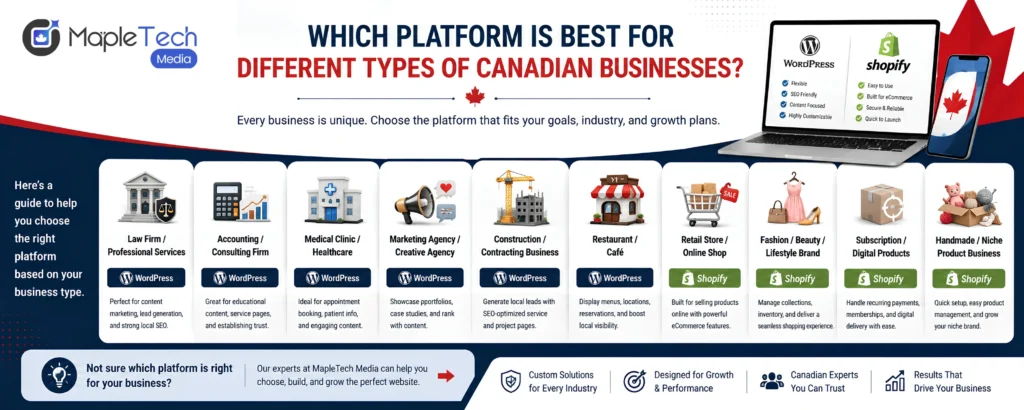
| Business Type | Recommended Platform | Why |
| Law Firm | WordPress | SEO, content marketing, lead generation |
| Accounting Firm | WordPress | Educational content and local SEO |
| Medical Clinic | WordPress | Appointment integrations and content |
| Marketing Agency | WordPress | Portfolio, blogs, SEO flexibility |
| Construction Company | WordPress | Local SEO and lead generation |
| Real Estate Agency | WordPress | Property listings and custom features |
| Restaurant | WordPress | Menus, reservations, local SEO |
| Retail Store | Shopify | Ecommerce-focused |
| Fashion Brand | Shopify | Product management and checkout |
| Beauty Products | Shopify | Online sales and inventory |
| Subscription Business | Shopify | Built-in recurring commerce options |
| Handmade Products | Shopify | Simple store setup |
WordPress Pros and Cons
Pros
- Highly customizable
- Excellent SEO capabilities
- Superior blogging and content management
- Full ownership of your website
- Thousands of themes and plugins
- Strong community support
- Flexible hosting options
- Ideal for long-term digital marketing
Cons
- Requires regular maintenance
- Greater learning curve
- Hosting must be managed separately
- Security depends on proper management
- Plugin compatibility occasionally requires attention
Shopify Pros and Cons
Pros
- Easy to use
- Fully hosted platform
- Excellent ecommerce functionality
- Secure checkout
- Reliable performance
- Automatic updates
- Strong customer support
- Fast store deployment
Cons
- Monthly subscription fees
- Additional app costs
- Less customization than WordPress
- More limited blogging capabilities
- Greater dependence on Shopify’s ecosystem
WordPress vs Shopify: Final Comparison
| Feature | WordPress | Shopify |
| Ease of Use | ⭐⭐⭐⭐☆ | ⭐⭐⭐⭐⭐ |
| SEO | ⭐⭐⭐⭐⭐ | ⭐⭐⭐⭐☆ |
| Content Marketing | ⭐⭐⭐⭐⭐ | ⭐⭐⭐☆☆ |
| Ecommerce | ⭐⭐⭐⭐☆ | ⭐⭐⭐⭐⭐ |
| Design Flexibility | ⭐⭐⭐⭐⭐ | ⭐⭐⭐⭐☆ |
| Security | ⭐⭐⭐⭐☆ | ⭐⭐⭐⭐⭐ |
| Maintenance | ⭐⭐⭐☆☆ | ⭐⭐⭐⭐⭐ |
| Scalability | ⭐⭐⭐⭐⭐ | ⭐⭐⭐⭐⭐ |
| Custom Development | ⭐⭐⭐⭐⭐ | ⭐⭐⭐☆☆ |
| Overall Flexibility | ⭐⭐⭐⭐⭐ | ⭐⭐⭐⭐☆ |
Our Recommendation for Canadian Businesses
There is no single winner because every business has different goals.
Choose WordPress if you:
- Want to rank higher in Google through SEO?
- Plan to invest in content marketing.
- Need advanced customization.
- Operate a service-based business.
- Want complete ownership and control?
- Expect your website to evolve over time.
Choose Shopify if you:
- Primarily sell products online.
- Want an all-in-one ecommerce solution?
- Prefer minimal technical maintenance.
- Need to launch quickly.
- Value simplicity and ease of management.
For many Canadian businesses, WordPress is the better long-term investment for building authority, generating leads, and supporting digital marketing strategies. Shopify remains an excellent option for businesses focused on ecommerce and operational simplicity.
Frequently Asked Questions
1. Is WordPress better than Shopify?
It depends on your goals. WordPress excels in flexibility, SEO, and content marketing, while Shopify is designed for streamlined ecommerce.
2. Which platform is better for SEO?
WordPress generally offers greater SEO flexibility through advanced plugins and technical customization.
3. Which platform is easier for beginners?
Shopify is easier to set up and manage, especially for users without technical experience.
4. Is Shopify good for Canadian businesses?
Yes. Shopify supports Canadian payment gateways, taxes, shipping options, and is widely used by Canadian retailers.
5. Can WordPress be used for ecommerce?
Absolutely. With WooCommerce, WordPress becomes a powerful ecommerce platform capable of supporting businesses of all sizes.
6. Which platform is more affordable?
The answer depends on your needs. WordPress can have lower ongoing costs for content-driven sites, while Shopify offers predictable pricing with hosting included.
7. Which platform offers better customization?
WordPress provides significantly greater customization because it is open-source and supports extensive themes, plugins, and custom development.
8. Which platform is more secure?
Both platforms are secure when managed properly. Shopify includes managed security, while WordPress requires proactive maintenance.
9. Can I migrate from WordPress to Shopify?
Yes. Businesses can migrate between platforms, although careful planning is recommended to preserve SEO performance and data.
10. Can I migrate from Shopify to WordPress?
Yes. Many businesses migrate to WordPress when they need more flexibility, stronger content management, or advanced SEO capabilities.
11. Which platform is better for service-based businesses?
WordPress is generally the preferred choice because of its superior blogging, SEO, and lead-generation capabilities.
12. Which platform is better for online stores?
Shopify is an excellent choice for businesses focused primarily on ecommerce, while WooCommerce on WordPress is ideal for stores requiring advanced customization.
Final Thoughts
Choosing between WordPress and Shopify is about selecting the platform that best supports your business objectives, not simply following trends.
If your strategy revolves around attracting organic traffic, publishing educational content, generating leads, and building a long-term digital presence, WordPress provides exceptional flexibility and scalability.
If your priority is launching a reliable online store quickly with minimal technical management, Shopify offers a streamlined solution that allows you to focus on sales and customer experience.
Whichever platform you choose, success ultimately depends on thoughtful planning, quality design, strong SEO, fast performance, and a customer-first approach. A professionally built website combined with an effective digital marketing strategy will deliver far greater results than the platform alone.
Ready to Build a Website That Supports Your Business Growth?
Your website is one of the most valuable investments your business can make. Choosing the right platform is only the beginning. The real impact comes from creating a website that attracts visitors, ranks well in search engines, and converts potential customers into loyal clients.
At MapleTech Media, we help Canadian businesses build high-performing WordPress and Shopify websites tailored to their unique goals. Whether you need a lead-generation website, a custom ecommerce store, or a complete digital marketing strategy, our team combines web development expertise with SEO, content marketing, PPC, and user experience best practices to deliver measurable results.
Contact MapleTech Media today to discuss your project and discover which platform is the best fit for your business. Together, we’ll create a website that supports your growth today and well into the future.
Digital Marketing Trends Every Canadian Business Should Watch in 2026