Introduction
The digital marketing landscape is evolving faster than ever before. Artificial intelligence is transforming how businesses create content, search engines are becoming more sophisticated, customer expectations continue to rise, and new technologies are reshaping how brands connect with their audiences.
For Canadian businesses, these changes present both opportunities and challenges.
Businesses that adapt to emerging digital marketing trends will be better positioned to attract customers, improve online visibility, and generate sustainable growth. Those that continue relying on outdated marketing tactics risk losing market share to more agile competitors.
Whether you operate a local business in Toronto, a growing eCommerce store in Vancouver, a professional services firm in Calgary, or a manufacturing company in Ontario, staying ahead of digital marketing trends is no longer optional, it’s essential.
Consumers today expect seamless online experiences. They research businesses before making purchasing decisions, compare reviews, engage with brands across multiple platforms, and expect personalized experiences tailored to their needs.
At the same time, Google’s search algorithms continue to evolve, artificial intelligence is becoming part of everyday marketing workflows, and privacy regulations are changing how businesses collect and use customer data.
These developments are transforming digital marketing across every industry.
In this comprehensive guide, we’ll explore the most important digital marketing trends every Canadian business should watch in 2026, explain why they matter, and provide practical recommendations you can implement to remain competitive.
Table of Contents
Why Digital Marketing Is Changing Faster Than Ever
The way Canadians search, shop, and interact with businesses has changed dramatically over the last few years.
Today’s customers rarely make purchasing decisions without conducting online research first.
Before choosing a product or service, they often:
- Search Google for local businesses.
- Compare prices and service offerings.
- Read Google Reviews.
- Visit company websites.
- Browse social media profiles.
- Watch videos and customer testimonials.
- Read blog articles and buying guides.
- Request quotes online.
This means your digital presence has become your first impression.
If your website is outdated, difficult to navigate, slow to load, or lacks valuable information, potential customers may leave before ever contacting your business.
Digital marketing is no longer just about attracting visitors, it’s about building trust throughout the customer journey.
Canadian businesses that invest in search engine optimization (SEO), high-quality content, paid advertising, user experience, and customer engagement are more likely to convert visitors into loyal customers.
As technology continues to evolve, businesses must embrace new strategies while maintaining a strong focus on customer needs.
Trend #1: Artificial Intelligence Is Transforming Digital Marketing
Artificial intelligence (AI) is no longer an emerging technology. It has become an essential component of modern digital marketing.
Businesses across Canada are using AI to improve efficiency, personalize customer experiences, and make smarter marketing decisions.
However, successful businesses understand that AI should enhance human expertise not replace it.
AI Is Making Marketing More Efficient
AI-powered tools can assist with:
- Keyword research
- Content planning
- Customer segmentation
- Marketing automation
- Email personalization
- Predictive analytics
- Advertising optimization
- Chatbots and customer support
- Data analysis
- Campaign reporting
These technologies help marketing teams save time while improving campaign performance.
For example, AI can identify trending search topics, recommend content ideas, analyze competitor performance, and predict customer behaviour using historical data.
This allows businesses to make more informed marketing decisions.
AI Content Still Needs Human Expertise
While AI can generate ideas and streamline workflows, it cannot replace genuine expertise, industry knowledge, or original insights.
Google continues to prioritize content that demonstrates:
- Experience
- Expertise
- Authoritativeness
- Trustworthiness (EEAT)
Businesses that rely solely on generic AI-generated content may struggle to differentiate themselves.
Instead, AI should be used to:
- Speed up research.
- Generate outlines.
- Analyze keywords.
- Organize information.
- Improve productivity.
Human experts should still contribute:
- Real-world experience.
- Original examples.
- Industry-specific knowledge.
- Canadian market insights.
- Case studies.
- Strategic recommendations.
This combination creates content that is both efficient to produce and genuinely valuable to readers.
AI Personalization Is Becoming Standard
Customers increasingly expect personalized experiences.
AI enables businesses to:
- Recommend relevant products.
- Personalize email campaigns.
- Display customized website content.
- Improve customer support.
- Predict purchasing behaviour.
- Deliver more relevant advertisements.
Businesses that provide personalized experiences often build stronger customer relationships and improve conversion rates.
Trend #2: SEO Is Becoming More Human-Centred
Search engine optimization remains one of the highest-return marketing investments for Canadian businesses.
However, SEO has changed significantly.
Success is no longer determined by keyword density or backlink quantity alone.
Instead, Google increasingly rewards websites that genuinely help users.
Helpful Content Is the New Standard
Google’s focus is simple:
Deliver the most useful content for every search.
This means businesses should create content that:
- Answers real customer questions.
- Demonstrates expertise.
- Solves practical problems.
- Provides original insights.
- Is well organized and easy to read.
- Reflects current information.
Rather than publishing dozens of short, generic articles, businesses should invest in comprehensive resources that thoroughly address a topic.
For example, instead of writing a 700-word article titled “What Is SEO?”, create a detailed guide that explains:
- What SEO is.
- How Google ranks websites.
- Local SEO.
- Technical SEO.
- Keyword research.
- Common mistakes.
- Practical implementation.
This approach aligns with Google’s Helpful Content principles while improving user satisfaction.
Search Intent Is More Important Than Keywords Alone
Modern SEO focuses on understanding why someone is searching.
For example, someone searching:
“Website development cost in Canada”
is likely comparing budgets before hiring a developer.
Someone searching:
“Best website development company in Toronto”
is much closer to making a purchasing decision.
Creating content that matches these different stages of the buyer’s journey improves both rankings and conversions.
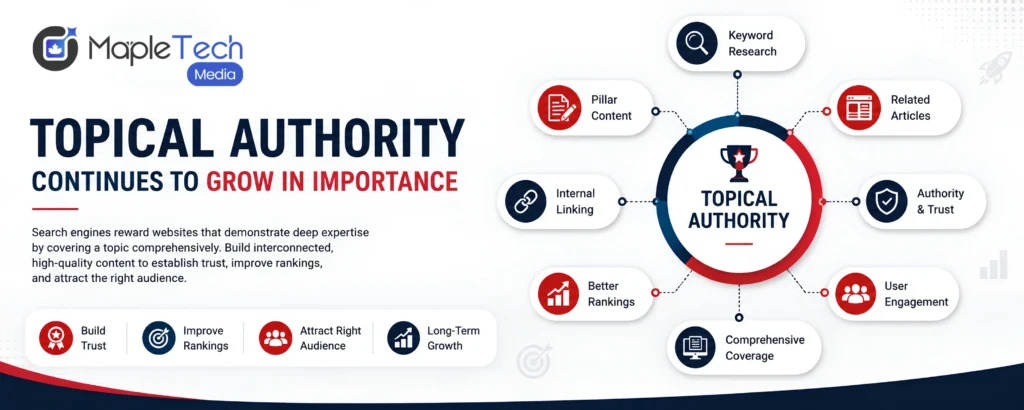
Topical Authority Continues to Grow in Importance
Google increasingly favours websites that demonstrate deep expertise across an entire subject area.
Instead of publishing unrelated blog posts, Canadian businesses should build interconnected content clusters.
For example, a digital marketing agency could create:
- SEO Guide
- Local SEO Guide
- Technical SEO
- Keyword Research
- Google Business Profile
- Link Building
- Content Marketing
- Google Ads
- Website Development
- Conversion Rate Optimization
Each article supports the others through internal linking, helping Google understand the website’s expertise.
This strategy is known as topical authority and has become one of the most effective long-term SEO approaches.
Trend #3: Local SEO Is Becoming Even More Valuable
For businesses serving customers in specific cities or regions, Local SEO continues to deliver some of the highest returns on investment.
Canadian consumers frequently search using location-based phrases such as:
- Marketing agency near me
- Dentist in Ottawa
- Roofing company Toronto
- Accountant Calgary
- Restaurant Vancouver
Google wants to show businesses that are both relevant and geographically close to the searcher.
To improve local visibility, businesses should focus on:
- Optimizing their Google Business Profile.
- Maintaining consistent business information across directories.
- Encouraging genuine customer reviews.
- Creating location-specific landing pages.
- Publishing locally relevant content.
- Earning backlinks from Canadian organizations and community websites.
Local SEO not only improves rankings in Google Search but also increases visibility in Google Maps, where many customers begin their search for nearby businesses.
For small and medium-sized businesses across Canada, investing in Local SEO is one of the most effective ways to attract qualified leads and compete with larger brands.
Trend #4: Short-Form Video Continues to Dominate Digital Marketing
If there is one content format that has transformed digital marketing over the last few years, it’s short-form video. Platforms like TikTok, Instagram Reels, YouTube Shorts, Facebook Reels, and even LinkedIn video have changed how people consume information online.
Canadian consumers now expect businesses to communicate through engaging, easy-to-digest videos rather than relying solely on written content or static images.
Whether you’re a local restaurant in Montreal, a law firm in Toronto, or a real estate agency in Vancouver, short-form videos can help you connect with potential customers, demonstrate expertise, and build trust.
Why Video Marketing Works
People process visual information much faster than text. A 30-second video can explain a service, answer a common question, or showcase customer success stories in a way that feels authentic and engaging.
Video also allows businesses to humanize their brand. Instead of simply telling customers what you do, you can show them your team, your process, and your results.
Ideas for Canadian Businesses
- Behind-the-scenes office tours
- Customer success stories
- Frequently asked questions
- Industry tips and educational content
- Product demonstrations
- Employee introductions
- Local community events
- Seasonal marketing campaigns
- Business updates
- “Day in the life” content
The goal isn’t to create Hollywood-quality videos. Authentic, informative, and consistent content often performs better than highly polished productions.
Trend #5: First-Party Data Is Becoming Essential
Privacy expectations continue to evolve, and businesses can no longer rely heavily on third-party cookies to understand customer behaviour.
Instead, companies must focus on collecting first-party data information that customers willingly share through direct interactions.
Examples include:
- Newsletter subscriptions
- Contact forms
- Quote requests
- Customer surveys
- Website accounts
- Purchase history
- Loyalty programs
- Live chat conversations
First-party data helps businesses better understand their audience while respecting privacy regulations.
Why This Matters
Businesses that build their own customer database are less dependent on changing advertising platforms and can create more personalized marketing campaigns.
For example, an HVAC company can send seasonal maintenance reminders to existing customers, while an eCommerce retailer can recommend products based on previous purchases.
Building trust and collecting data ethically will become an increasingly important competitive advantage.
Trend #6: Personalization Is No Longer Optional
Today’s customers expect businesses to understand their needs.
Generic marketing messages are becoming less effective because consumers are exposed to thousands of advertisements every day.
Personalization helps your business stand out by delivering relevant experiences.
Examples include:
- Personalized email campaigns
- Product recommendations
- Dynamic website content
- Location-specific offers
- Behaviour-based advertising
- Customized landing pages
Imagine a visitor from Calgary arriving on your website.
Instead of showing general information, your website could highlight:
- Local services
- Customer reviews from Calgary
- Relevant case studies
- City-specific promotions
These personalized experiences create stronger connections and often improve conversion rates.
Trend #7: Omnichannel Marketing Creates Better Customer Experiences
Customers rarely interact with a business through a single channel.
A typical customer journey may look like this:
- Discover your business through Google Search.
- Visit your website.
- Follow your business on Instagram.
- Read online reviews.
- Subscribe to your newsletter.
- Click a Google Ad.
- Contact your business through a contact form.
- Become a customer.
Every interaction influences the final purchasing decision.
This is why successful businesses invest in an omnichannel marketing strategy.
Rather than treating each marketing platform separately, every channel should work together to create a seamless customer experience.
Your marketing channels should support each other:
- SEO attracts organic visitors.
- Blog content builds trust.
- Social media increases engagement.
- Email marketing nurtures leads.
- Google Ads generates immediate visibility.
- Your website converts visitors into customers.
Consistency across these channels strengthens your brand and improves customer confidence.
Trend #8: Google Ads Is Becoming Smarter Through Automation
Google Ads remains one of the fastest ways for Canadian businesses to generate qualified leads.
However, campaign management has changed dramatically.
Artificial intelligence now plays a significant role in:
- Smart Bidding
- Performance Max campaigns
- Audience targeting
- Ad optimization
- Conversion tracking
- Budget allocation
Automation helps businesses improve campaign performance, but it doesn’t eliminate the need for strategy.
Human expertise is still essential for:
- Keyword research
- Audience analysis
- Landing page optimization
- Ad copywriting
- Conversion tracking
- Campaign reporting
Businesses that combine AI-powered automation with experienced marketing professionals generally achieve stronger results.
Trend #9: Website Experience Is a Competitive Advantage
Your website is no longer just an online brochure.
It has become your digital storefront, sales representative, and customer service centre.
If visitors encounter a slow, outdated, or confusing website, they may leave before contacting your business.
Google also considers user experience when evaluating search rankings.
Important Website Factors
Fast Loading Speed
Pages should load quickly on both desktop and mobile devices.
Mobile-First Design
More Canadians browse on smartphones than ever before.
Your website should provide an excellent experience regardless of screen size.
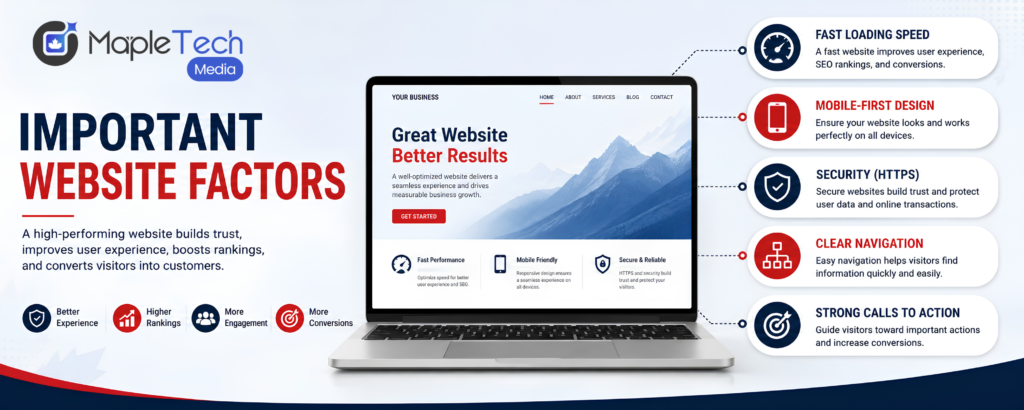
Accessibility
An accessible website allows more people to interact with your business while supporting compliance with accessibility standards.
Clear Navigation
Visitors should quickly find:
- Services
- Pricing
- Contact information
- About page
- Blog
- FAQs
Strong Calls to Action
Every page should guide visitors toward a specific next step.
Examples:
- Request a Quote
- Book a Consultation
- Contact Our Team
- Download Our Guide
A well-designed website supports both user experience and conversion rate optimization (CRO), helping turn visitors into paying customers.
Trend #10: Content Marketing Continues to Build Long-Term Authority
Content marketing remains one of the most valuable investments for businesses looking to grow organically.
Instead of constantly paying for traffic through advertising, businesses can create valuable resources that continue attracting visitors over time.
Examples include:
- Blog articles
- Buying guides
- Industry reports
- Case studies
- Videos
- Infographics
- Webinars
- Downloadable resources
High-quality content answers customer questions, demonstrates expertise, and supports every stage of the buyer’s journey.
Building Topical Authority
One of the biggest SEO trends in 2026 is topical authority.
Google increasingly rewards websites that thoroughly cover an entire subject rather than publishing isolated articles.
For example, if your business offers digital marketing services, you should create a network of related content, such as:
SEO
- SEO for Small Businesses in Canada
- Technical SEO Guide
- Local SEO Checklist
- Keyword Research Guide
- Link Building Strategies
Website Development
- Website Development Cost in Canada
- Website Redesign Guide
- Website Speed Optimization
- UX Best Practices
- Conversion Rate Optimization
Google Ads
- Google Ads Cost in Canada
- Performance Max Guide
- PPC Strategy
- Google Ads vs SEO
- Landing Page Optimization
Social Media
- Instagram Marketing
- LinkedIn Marketing
- Facebook Advertising
- Social Media Strategy
- Social Media Content Calendar
Content Marketing
- Content Strategy
- Pillar Pages
- Topic Clusters
- SEO Copywriting
- Evergreen Content
Each article strengthens the others through internal linking, making it easier for search engines to understand your expertise.
This strategy not only improves rankings but also keeps visitors engaged by guiding them to related resources.
Trend #11: Building Brand Trust Through EEAT
As digital marketing becomes more competitive, one factor continues to separate successful businesses from the rest: trust.
Google’s search algorithms increasingly prioritize websites that demonstrate Experience, Expertise, Authoritativeness, and Trustworthiness (EEAT). While EEAT isn’t a direct ranking factor on its own, it represents the qualities Google looks for when determining whether content deserves to rank.
For Canadian businesses, building trust is no longer optional. Consumers want to know who they’re buying from, why they should trust your business, and whether your company has the expertise to solve their problem.
How to Build EEAT
Demonstrate Real Experience
Share genuine case studies, client success stories, before-and-after examples, and lessons learned from real projects. Instead of simply explaining what SEO or digital marketing is, show how you’ve helped businesses improve their online presence.
Showcase Industry Expertise
Publish comprehensive, well-researched content that answers common customer questions. Long-form guides, how-to articles, and educational resources establish your business as a reliable source of information.
Build Authority
Authority develops over time through:
- Consistent publishing
- High-quality backlinks
- Positive customer reviews
- Media mentions
- Speaking engagements
- Industry certifications
- Community involvement
Strengthen Trust
Make it easy for visitors to trust your business by including:
- Clear contact information
- About Us page
- Team profiles
- Client testimonials
- Privacy Policy
- Terms & Conditions
- HTTPS security
- Transparent pricing where appropriate
When customers trust your brand, they’re more likely to contact you, recommend your services, and become long-term clients.
Trend #12: Data-Driven Marketing and Analytics
Successful marketing decisions are based on data not assumptions.
Canadian businesses that regularly measure performance can identify what’s working, eliminate ineffective strategies, and continuously improve their results.
Instead of asking:
“Are our marketing campaigns working?”
You should be asking:
- Which channels generate the most leads?
- Which blog articles attract the most traffic?
- Which landing pages convert the best?
- Which keywords generate qualified enquiries?
- Which campaigns produce the highest return on investment (ROI)?
Answering these questions requires accurate tracking.
Key Metrics Every Business Should Monitor
Website Traffic
Monitor:
- Organic traffic
- Direct traffic
- Referral traffic
- Paid traffic
- Social media traffic
Understanding where visitors come from helps you allocate your marketing budget more effectively.
Conversion Rate
Traffic alone doesn’t grow a business.
Track how many visitors:
- Request a quote
- Submit a contact form
- Call your business
- Book a consultation
- Make a purchase
Improving your conversion rate often delivers a greater return than simply increasing traffic.
Keyword Rankings
Monitor your visibility for important search terms such as:
- Digital Marketing Agency in Canada
- SEO Services Canada
- Web Development Canada
- Local SEO Canada
Ranking improvements often indicate that your content strategy is working.
Customer Acquisition Cost (CAC)
Understanding how much it costs to acquire a customer helps you measure marketing profitability.
Return on Investment (ROI)
Every marketing campaign should contribute measurable business value.
Track:
- Revenue generated
- Leads acquired
- Cost per lead
- Customer lifetime value
Data-driven decisions help businesses scale more efficiently.
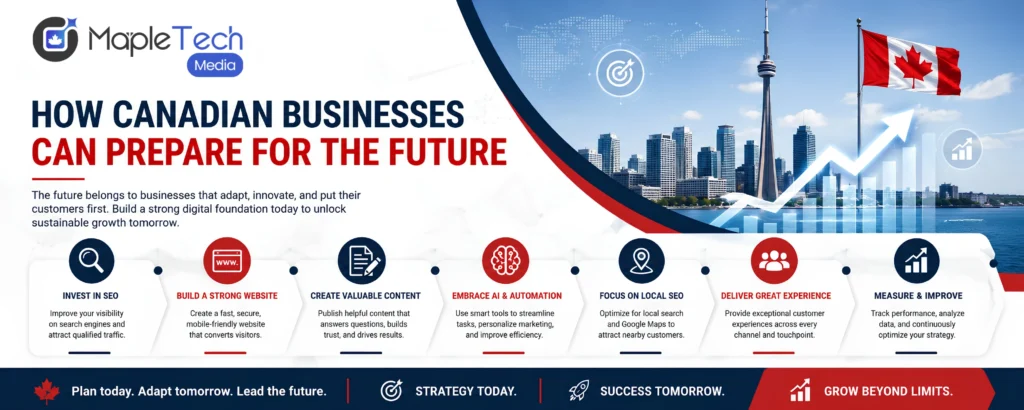
How Canadian Businesses Can Prepare for the Future
Digital marketing will continue evolving, but businesses don’t need to chase every new trend.
Instead, focus on building a strong foundation.
1. Invest in SEO
SEO remains one of the highest-return long-term marketing investments.
Create valuable content, optimize your website, and build topical authority.
2. Improve Your Website
Your website should be:
- Fast
- Mobile-friendly
- Accessible
- Secure
- Easy to navigate
- Conversion-focused
A great website supports every other marketing channel.
3. Create Helpful Content
Publish content that genuinely helps your audience.
Answer common questions.
Share industry insights.
Solve customer problems.
Helpful content builds trust while supporting long-term SEO.
4. Embrace AI Responsibly
Use AI to improve efficiency not replace expertise.
Successful businesses combine AI-powered tools with human creativity and strategic thinking.
5. Strengthen Your Local Presence
Optimize your:
- Google Business Profile
- Local landing pages
- Customer reviews
- Business directories
Local visibility remains one of the most effective ways to generate qualified leads.
6. Diversify Your Marketing Channels
Don’t rely on one source of traffic.
Build a balanced strategy that includes:
- SEO
- Google Ads
- Social Media
- Email Marketing
- Content Marketing
- Website Optimization
Diversification reduces risk and supports long-term growth.
Digital Marketing Checklist for 2026
Use this checklist to evaluate your current marketing strategy.
✅ Mobile-friendly website
✅ Fast loading speed
✅ Secure HTTPS website
✅ Optimized Google Business Profile
✅ SEO strategy
✅ Keyword research
✅ Content marketing plan
✅ Blog publishing schedule
✅ Social media strategy
✅ Google Ads campaign
✅ Email marketing
✅ Marketing automation
✅ Conversion tracking
✅ Google Analytics 4
✅ Customer review strategy
✅ Local SEO optimization
✅ Internal linking strategy
✅ Video marketing plan
✅ Lead generation system
✅ Monthly performance reporting
Common Digital Marketing Mistakes to Avoid
Even experienced businesses make mistakes that limit their online growth.
Avoid these common issues:
- Publishing inconsistent content.
- Ignoring SEO.
- Treating AI-generated content as a replacement for expertise.
- Failing to optimize for mobile users.
- Neglecting Local SEO.
- Running Google Ads without conversion tracking.
- Ignoring customer reviews.
- Creating disconnected marketing campaigns.
- Measuring vanity metrics instead of business outcomes.
- Failing to update outdated website content.
Avoiding these mistakes gives your business a stronger competitive advantage.
Frequently Asked Questions
1. What is the biggest digital marketing trend in 2026?
Artificial intelligence, personalized customer experiences, topical authority, and Local SEO are among the most influential trends shaping digital marketing in 2026.
2. Is SEO still worth investing in?
Yes. SEO continues to be one of the most cost-effective long-term strategies for generating qualified organic traffic and improving online visibility.
3. Why is Local SEO important for Canadian businesses?
Most customers search for businesses within their local area. Local SEO helps your business appear in Google Search and Google Maps when nearby customers are looking for your products or services.
4. How often should businesses publish new content?
Consistency matters more than volume. Publishing high-quality content on a regular schedule whether weekly or bi-weekly helps build topical authority and keeps your website relevant.
5. Should businesses use AI to create content?
AI is a valuable tool for research, planning, and productivity. However, human expertise, original insights, and real-world experience remain essential for creating trustworthy content.
6. Which marketing channel offers the best ROI?
There isn’t a single answer. SEO, content marketing, email marketing, and paid advertising each serve different purposes. A balanced strategy generally delivers the strongest long-term results.
7. Why is website speed important?
A faster website improves user experience, reduces bounce rates, supports SEO, and increases conversion rates.
8. What is topical authority?
Topical authority is built by publishing comprehensive, interconnected content covering an entire subject rather than isolated articles.
9. How can small businesses compete with larger brands?
By focusing on local SEO, creating high-quality content, building customer trust, and providing exceptional service, small businesses can compete effectively within their target markets.
10. What should Canadian businesses prioritize in 2026?
Businesses should prioritize customer experience, helpful content, AI-assisted marketing, Local SEO, website performance, and data-driven decision-making.
Final Thoughts
Digital marketing continues to evolve, but one principle remains constant: businesses that prioritize their customers will always have a competitive advantage.
Artificial intelligence, automation, personalization, and evolving search algorithms are changing how companies market themselves, but these technologies are most effective when paired with genuine expertise, valuable content, and a strong commitment to helping customers solve real problems.
For Canadian businesses, success in 2026 won’t come from adopting every new platform or trend. It will come from building a solid digital foundation that includes a high-performing website, a consistent content strategy, effective SEO, meaningful customer engagement, and ongoing performance analysis.
The businesses that invest in these fundamentals today will be better positioned to adapt to future changes, strengthen customer relationships, and achieve sustainable long-term growth.
Ready to Future-Proof Your Digital Marketing Strategy?
Keeping up with digital marketing trends can be challenging, especially when you’re focused on running your business. At MapleTech Media, we help Canadian businesses navigate the changing digital landscape with customized strategies designed to increase visibility, attract qualified leads, and drive measurable growth.
Whether you need SEO, website development, Google Ads management, content marketing, social media marketing, or a complete digital marketing strategy, our team is here to help you build a stronger online presence and stay ahead of the competition.
Get in touch with MapleTech Media today to discover how a results-driven digital marketing strategy can help your business thrive in 2026 and beyond.